

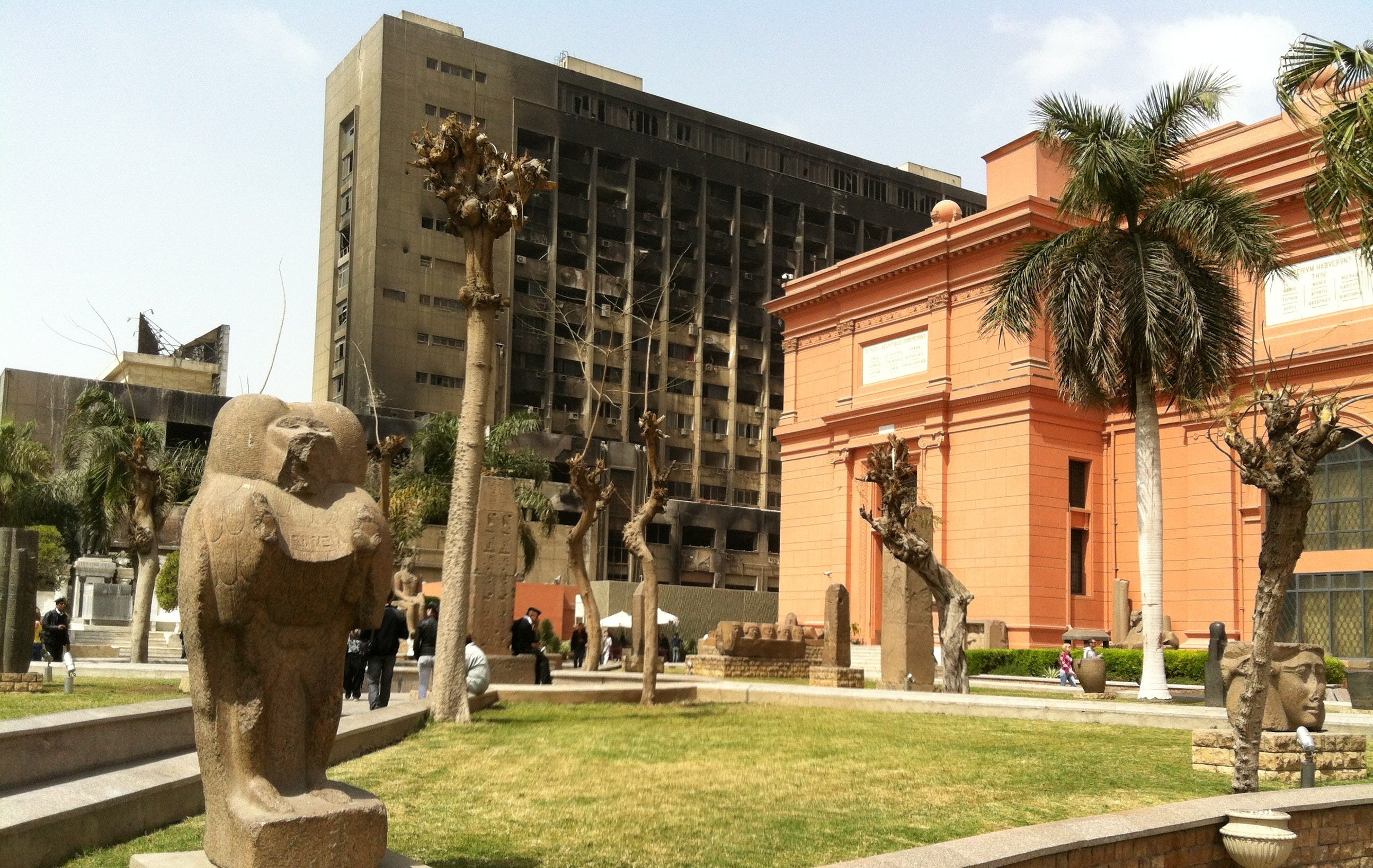
Nine days in Cairo and the thing that gets you, walking the streets around Tahrir in the third week of March, is how ordinary the city is.
Not resolved. Not quiet. The Supreme Council of Armed Forces is still governing. Presidential elections are three months out. The political outcome of what happened here thirteen months ago is unclear to everyone I’ve spoken with, and they are not shifts about saying so. But ordinary in the way that cities find their way back to themselves: cafes at full capacity, newspapers being read aloud across tables, arguments conducted at the volume Cairenes conduct all conversations. People have found their rhythm again.
What the walls carry is different. Murals and stencilled faces cover central Cairo in a record that no newspaper could have produced fast enough. Faces of the dead, half-painted-over slogans reapplied on top of what the authorities tried to erase. The layers go back eighteen months. You can read the sequence if you look. Each layer marks a day when someone needed to say something faster than print allowed.
In a cafe twenty minutes from the square, two men at the table beside me are on their phones. Both are on Facebook. I watch one of them scroll, stop, tap something, scroll on. The gesture is unremarkable. He could be in London.
That unremarkableness is worth sitting with.
Between January 25 and February 11, 2011, that same scroll, that same feed, that same tap, served as the organising layer for a revolution that removed a president who had governed for thirty years. Wael Ghonim’s page, “We Are All Khaled Said,” had 473,000 members when the protests began. It had over two million when Mubarak resigned. The page still exists. The president is gone.
What the platform gave the protests was not just reach. A newspaper has reach. A broadcaster has reach. The specific thing Facebook and Twitter gave the Tahrir movement was simultaneity: the ability to counter state disinformation and distribute footage across thirty countries while the event was still unfolding, without requiring the institutional backing or advance logistics that any prior form of coordinated dissent depended on. The whole weight of what organised resistance used to need, physical presence, print infrastructure, official sanction, routed through devices in people’s pockets.
Six weeks ago, Facebook filed for its IPO. The filing targets a $5 billion raise at a valuation the market is reading around $100 billion. The pitch to investors is advertising: 845 million users, detailed demographic data, engagement patterns that allow precise targeting. The picture being sold to Wall Street is an attention business.
The platform that organised this city’s revolution and the platform pitching Wall Street are the same platform.
The prospectus asks no one to reconcile that. The two things coexist as a structural feature with no name yet, and the gap between them does not appear to be troubling anyone in the filing.
Walking back toward the square that afternoon, I kept returning to what the Arab Spring settled, because the surface reading, that social media is powerful, is too thin to be useful. Plenty of things are powerful. The specific thing that happened in January and February 2011 is that these platforms revealed themselves as infrastructure at the intersection of politics, resistance, and calls for change, in a way no communications technology had managed at the same time before.
Revolutions cauterise contested questions. Before Tunisia and Egypt, a reasonable person could still argue that social media was a surface for self-expression that happened to get political occasionally. That argument is over. The question it opens is different, and nobody writing about these companies seems to be asking it yet: if these platforms are infrastructure, if they are the layer through which organised dissent now routes, what obligations come with that, and to whom?
Pinterest launched to the public last week. The Instagram acquisition rumours are pricing around a billion dollars. The social layer is multiplying and every company building it is pricing itself as an advertising business, which is coherent as a pitch and strange as a description of what the technology does when actual pressure is applied to it.
The man in the cafe scrolls on. Outside, a half-painted slogan on the wall opposite asks something in Arabic I can’t fully read. I don’t need to. The walls of central Cairo have been answering that question for over a year, layer by layer, in a language that moves faster than any press cycle could follow.
The platforms that helped write that answer are now pitching a different story to investors six thousand miles away. Both things are true at the same time. The distance between them is the thing nobody is pricing.