

The shoe weighs 97 grams. For context, an Air Force 1 weighs 465. The Adizero Adios Pro Evo 3 costs about $500 and looks like someone kitesurfed through an engineering lab. Adidas borrowed textile patterns from kite sails to cut weight without sacrificing shape. Their designers weren’t sure 97 grams would survive a marathon distance.
It survived. On Sunday, April 27, 2026, Sabastian Sawe wore a pair across the London Marathon finish line in 1 hour, 59 minutes, and 30 seconds. The first human being to officially run 26.2 miles in under two hours. His training partner, Yomif Kejelcha, crossed 11 seconds later. Two men, one race, same shoe, same wall, both through it in the same morning.
By Monday, Adidas stock had climbed roughly 2%. The company’s market cap grew by hundreds of millions of euros on the back of one man’s legs and 194 grams of foam and fabric.
The Bannister File
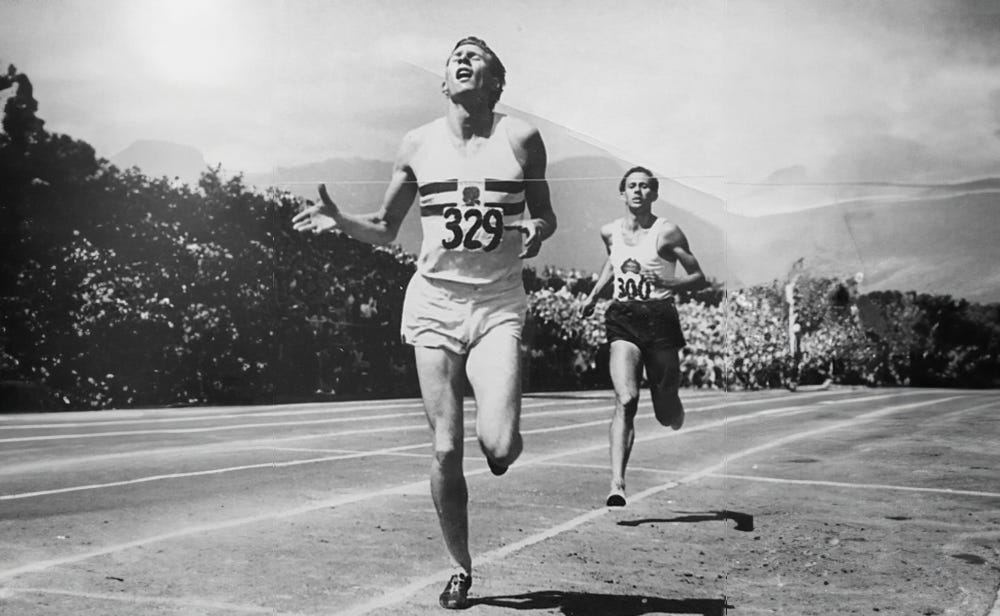
On May 6, 1954, Roger Bannister ran a mile in 3 minutes 59.4 seconds at Iffley Road track in Oxford. He was a 25-year-old medical student. In 1945, physiologist A.V. Hill had calculated that human muscle couldn’t sustain the oxygen consumption required for a sub-four mile. Track coaches repeated the number like doctrine. Bannister ran 3:59.4 anyway, beating Hill’s ceiling by 0.6 seconds.
What happened next matters more than the record itself. John Landy broke Bannister’s time 46 days later. By the end of 1956, four runners had gone sub-four. Within three years, the record dropped to 3:54.5. Today, high school athletes run sub-four miles.
The barrier wasn’t physiological. It was psychological. Once Bannister proved the mile could be broken, other runners believed they could break it too. Belief changes training. Training changes times.
That’s a shatter point. And shatter points don’t just happen in sports.
The Shoe Nobody Trusted
Nike got to the carbon-plate party first. Their Vaporfly line, launched in 2017, inserted a curved carbon-fibre plate into a thick, bouncy midsole. Runners got faster. Records fell. The industry treated the plate as the breakthrough.
Adidas went a different direction. The Adizero Adios Pro Evo 3 doesn’t use a full carbon plate. It uses a carbon rod structure—lighter and more flexible—combined with a midsole foam engineered for maximum energy return at minimum weight. The upper borrows kite-sail construction to cut grams without sacrificing durability.
The result is a shoe that weighs less than a third of its competitors and carries the fastest marathon in history.
The details show how breakthroughs actually happen. The accepted wisdom said carbon plates were the path. Adidas looked at the problem differently. They asked a harder question: not “how do we add something that helps,” but “how do we remove everything that doesn’t.”
Most founders face this exact problem. The industry consensus says do X. It works. It’s 2% better than last quarter, which is real progress, except you need 20%, and X will never get you there.
Three Industries About to Shatter
The shoe and the mile are clean stories. Real breakthroughs are usually messier—slower, smaller, then sudden. The architecture of the breakthrough is the same.
Machine learning and large action models. Two years ago, the field moved from language models that could describe the world to action models that could operate within it. Progress has been incremental. Models complete tasks 5% better this quarter than last quarter. But somewhere in that accumulation, a threshold exists where an AI agent can reliably complete a full workstream, not just a task. The teams building toward this line recognize when something shifts. One researcher at a major lab told me they talk about “the week it stopped being unreliable”—not a gradual improvement, but a moment. That moment is a shatter point. After it, the capability goes vertical.
Drone autonomy. Commercial drones fly autonomously in open airspace. The gap is in constrained environments—warehouses, buildings, disaster zones—where GPS drops out and obstacles are unpredictable. Each generation gets 10% better at avoiding collisions. Then one generation gets 80% better, because the architecture changes, not the optimization. The companies that recognize this shift before it happens will own the logistics layer.
Commercial space travel. SpaceX’s Falcon 9 first landed in December 2015. Before that, rockets were single-use. After, they weren’t. The cost per kilogram to low Earth orbit dropped from $54,500 (Space Shuttle) to roughly $2,720. The next shatter point is orbital manufacturing. When a factory in orbit produces a material that can’t be made under gravity, the economics of space travel flip from expense to investment.
Each field tells the same story: progress looks linear, then it doesn’t.
The Halo Economy
The stock market understood the moment before the business did. Investors priced in something that hadn’t happened yet: millions of recreational runners buying a $500 shoe because a Kenyan they’d never heard of wore it to a world record.
This isn’t irrational. Nike proved the model with Breaking2 in 2017, when Eliud Kipchoge ran an unofficial 1:59:40 in Vaporfly prototypes. Nike’s running shoe revenue grew 20% the following year. The halo effect of a single athletic achievement translated directly into consumer behavior and stock price.
Adidas just pulled off the same trick, except their version is official. Sawe’s 1:59:30 is a ratified world record. Kipchoge’s was an exhibition. The difference matters to runners, to governing bodies, and to the marketing teams who will build the next three years of campaigns around this moment.
For founders and investors, the lesson is specific. A product demo beats six months of incremental marketing because it’s proof, not promise. One customer case study, one moment of evidence compounds in ways that a spreadsheet can’t predict.
Where You Are in the Curve
The hardest part of any building phase is knowing whether you’re in the grinding years or the last mile before the break. The runners who chased sub-two didn’t know if 2026 was the year. The engineers who built the shoe didn’t know if 97 grams was the right number. They made the best decisions they could with the data they had and hoped the physics would cooperate.
If you’re building in AI, in autonomy, in space, in anything where progress is measured in single-digit percentages, this is the question worth sitting with: are you optimizing an old architecture, or are you building the one that makes the old architecture irrelevant?
Adidas didn’t make a better Nike shoe. They made a different shoe. Bannister didn’t train harder than the runners before him. He trained differently. Sawe didn’t run a faster marathon. He ran a first one.
The next shatter point in your industry is coming. The only question is whose shoe will be on the foot of the person who gets there first.