

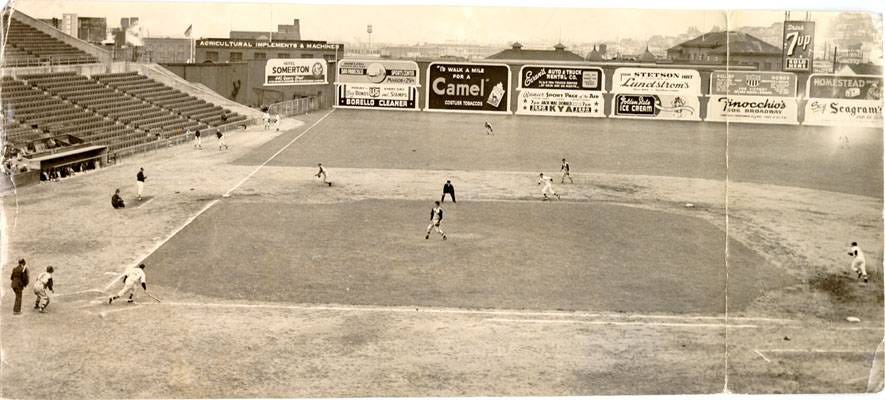
In the winter of 1995, a relatively unknown federal judge in New York named Sonia Sotomayor walked into a courtroom and changed the course of baseball. She did not swing a bat or throw a pitch. She issued an injunction ordering the owners to restore the work rules of the expired contract. The strike had been running for seven and a half months. The World Series had been cancelled for the first time in ninety years. Two days later, the players returned to work. The strike was over. And the salary cap that the owners had demanded was dead.
That ruling set the terms of every labor negotiation that followed. The owners never formally proposed a hard cap again. Until last Thursday.
Here is the odd thing about the proposal MLB owners put on the table this week. It is not the same proposal they made in 1994. It is a better one. And the players might actually want it.
The numbers are these. A ceiling of $245.3 million. A floor of $171.2 million. A 50-50 split of centralized media revenue. A phase in period for teams that exceed the cap. A seven year deal. Eight teams would need to cut payroll. Those teams are the Dodgers at $415.2 million, the Mets at $379.2 million, the Yankees at $339.6 million, Toronto at $319.5 million, Philadelphia at $315.2 million, Boston at $263.7 million, San Diego at $260.1 million, and Atlanta at $247.9 million. The Dodgers alone sat $170 million above the proposed ceiling.
Twelve teams would need to add payroll. A combined total of $617 million to reach the $171.2 million floor. Those teams are Miami at $81.8 million, Cleveland at $95.7 million, Tampa Bay at $108.2 million, the White Sox at $108.6 million, St. Louis at $114.4 million, Washington at $119.1 million, Pittsburgh at $122.6 million, Minnesota at $125.6 million, Milwaukee at $130.9 million, the Athletics at $139.2 million, Colorado at $142.2 million, and Cincinnati at $148.8 million.
The union said no immediately. This is what unions do. But here is the puzzle that Sotomayor’s ruling created, and it is the puzzle that this proposal is trying to solve. The 1994 strike was about the owners wanting a cap and the players refusing to accept one. The players won that fight. But winning the fight meant preserving a system where the Dodgers can spend $515 million on payroll and luxury tax while the Miami Marlins spend $68.7 million. Where the Dodgers alone outspend the bottom six teams combined. Where the last World Series winner from outside the top eight markets was the 2015 Kansas City Royals. Where a decade of champions have come from the same handful of cities.
Winning the fight meant preserving a system where Sandy Alcantara wins a Cy Young Award for the Marlins and gets traded a year later because the Marlins cannot afford to keep him.
The leagues that adopted caps all went through something like this. None of them did it easily. The teething pains of every cap system tell the same story. The players fight it. The owners demand it. Eventually both sides realize that the alternative is worse.
Consider the NFL. The modern NFL salary cap was adopted in 1994, but the road to that moment began seven years earlier with a strike that nearly broke the union. In 1987, NFL players walked out for 24 days. The owners responded by fielding replacement players. Scabs. For three weeks, the league played games with rosters full of taxi drivers, construction workers, and former college players who had washed out of the sport. The games were terrible. The television ratings held up anyway. The strike collapsed. The union accepted a deal that gave them free agency in exchange for a cap that would not arrive for another seven years. When the cap finally came in 1994, it was the compromise that ended a decade of labor warfare. Since then, fourteen different teams have reached the Super Bowl in fifteen seasons.
The NBA had a cap as early as 1946, dropped it, and brought it back in 1984. That return was relatively peaceful. But by 1998, the relationship between the owners and the players had deteriorated so badly that the league locked out the players for 191 days. Michael Jordan retired. The season was reduced to 50 games. The All Star Game was cancelled. The union lost. The owners got a maximum salary and a stricter cap structure that has defined the league ever since.
The NHL experienced the most catastrophic version of this fight. In 2004, the owners locked out the players over the demand for a hard cap tied to revenue. The players held firm for an entire year. The entire 2004-05 season was cancelled. The Stanley Cup was not awarded for the first time since 1919, when a Spanish flu pandemic stopped the finals. When the union finally broke, the cap that arrived was the hardest in North American sports. A hard cap with a salary floor. The result was that Chicago, Los Angeles, and St. Louis won their first championships in decades. Small market teams like Nashville and Winnipeg became consistent contenders. The league that emerged from the lockout was more competitive than the league that entered it.
MLS adopted a cap from its inception, but only because the league was barely surviving. The early years of MLS were defined by teams folding and merging. The cap was not a philosophical stance. It was a survival mechanism. Without it, the league would have died.
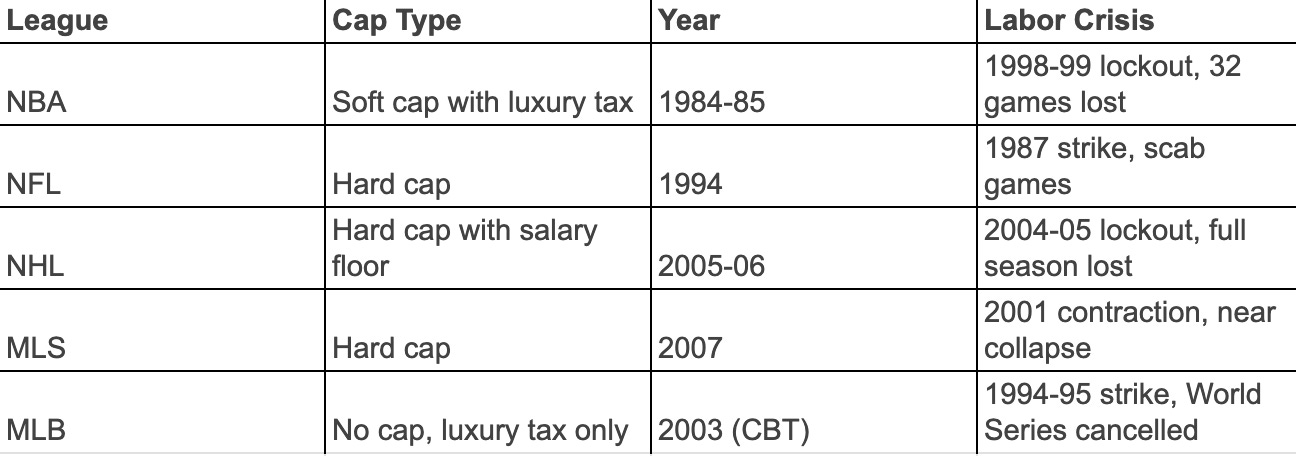
The table tells a story the numbers alone cannot. Every cap that exists today was built on the wreckage of a labor dispute. The question is not whether baseball will eventually have a cap. The question is how much damage both sides are willing to absorb before they agree to one.
Now consider the sport that has never solved this problem and is watching baseball’s fight with particular interest. European football.
The Premier League has no salary cap. It has Financial Fair Play regulations, which limit clubs to spending a percentage of their revenue. That is a soft cap under a different name. It allows Manchester City to outspend smaller clubs by factors of ten, so long as the revenue backs it up. FFP was supposed to prevent clubs from spending beyond their means. It was supposed to create competitive balance. Instead, it locked in the hierarchy. The clubs that already had the biggest revenues could still spend the most. The clubs that wanted to catch up found their spending artificially restrained.
The result is a Champions League that has become a closed shop by stealth. Real Madrid has won five of the last eleven Champions League titles. Manchester City won their first in 2023. Bayern Munich dominates the Bundesliga. PSG dominates Ligue 1. The gap between the super clubs and everyone else grows every year. The European Super League was an attempted response to this tension. The big clubs wanted a closed league with guaranteed revenue because the open system was too unpredictable for their business models. The Super League collapsed under fan pressure, but the problem that created it did not go away.
This is where the counterargument to the MLB proposal lives. FFP did not fix competitive imbalance in European football. It made it worse. A soft cap tied to revenue allows the richest clubs to keep being the richest clubs. A hard cap would redistribute talent. But the Premier League clubs with the most revenue do not want a hard cap. Neither does Real Madrid. Neither does Bayern Munich. They benefit from the current system.
The Premier League’s proposed squad cost rule would limit clubs to spending 85 percent of their revenue on player wages, transfers, and agent fees. That is a hard cap by another name, and the players union in England is fighting it for the same reasons the MLBPA is fighting the MLB proposal. The Professional Footballers Association has called the rule a restriction on player wages. The clubs argue it is necessary for the long term financial stability of the league. Same debate. Different accents.
PSG is the clearest example of the problem. PSG is owned by Qatar Sports Investments. The club dominates Ligue 1, a league that generates significantly less television revenue than the Premier League, La Liga, or Serie A. PSG wins the French league almost every season. Winning their domestic league earns them about 15 million euros. The 19th place team in the Premier League earns more than that in television money alone. PSG cannot compete with Manchester City or Real Madrid for the top tier of global talent because their league revenue cannot support it. They dominate a weak league and cannot break through in the strong one.
The same structural problem applies to Ajax, Benfica, Porto, and every club in leagues that are not the Premier League. They develop talent. They sell it to bigger clubs. They start over. It is the same cycle that the Marlins operate under. Different sport, different continent, same structural trap.
This is the deeper question that the MLB proposal raises. A cap with a floor works well in closed leagues where every team operates in the same economic framework. The NFL, NBA, and NHL are closed systems. No promotion. No relegation. Every team has a franchise. The cap works because the league controls the economics. European football is an open system. Promotion and relegation mean that the economics of each club are tied to its performance, its local market, and its global brand. A hard cap would be harder to implement in that environment because the range of club revenues is so wide.
Baseball does not have that problem. Baseball is a closed league. Every team has a franchise. Every team operates in the same economic framework. The only variable is how much the owner chooses to spend. The proposal on the table removes that variable.
The MLBPA has spent three decades telling itself that any cap is bad. But the sport has changed around them. The Dodgers are spending half a billion dollars. The Marlins are spending less than the Dodgers spend on their infield. The union’s argument is that the current system produces unicorn contracts like Juan Soto’s $765 million deal, the richest in team sports history. Patrick Mahomes is the highest paid player in the NFL. His contract is $450 million over ten years. Jayson Tatum is the highest paid player in the NBA. His contract is $314 million over five. Soto’s deal is bigger than both combined. The union points to Soto and says the system works.
But the median MLB salary has barely moved. The minimum salary sits at $780,000. Revenue has grown 247 percent since 2003. Player payroll has grown 149 percent. The difference is flowing into franchise values that have doubled and tripled. The owners are getting richer while the players share of the revenue declines. A hard cap with a 50-50 revenue split gives players a guaranteed share of the growth. The current system gives them the hope of a unicorn contract and the reality of ownership taking a bigger cut.
The current CBA expires December 2. A lockout next winter is expected. Real negotiations will not intensify until late February or March 2027, when the threat of lost games and lost revenue focuses both sides. The last time ownership and labor fought this fight, they lost a World Series. This time the stakes are higher because the structural divide is wider. Sotomayor’s 1995 injunction preserved a system that created a generation of Dodgers dominance and Marlins futility. The proposal on the table is the first real attempt to change that system.
The question is whether the players will recognize that the proposal in front of them is not the one their predecessors fought in 1994. The numbers are different. The structure is different. The floor changes everything. And the history of every other sport that has made this journey suggests that the pain of getting there is real, but the outcome on the other side is a better product.
Every other major sport that crossed this bridge came out the other side stronger. Baseball has to decide whether it wants to be the exception or the proof.