

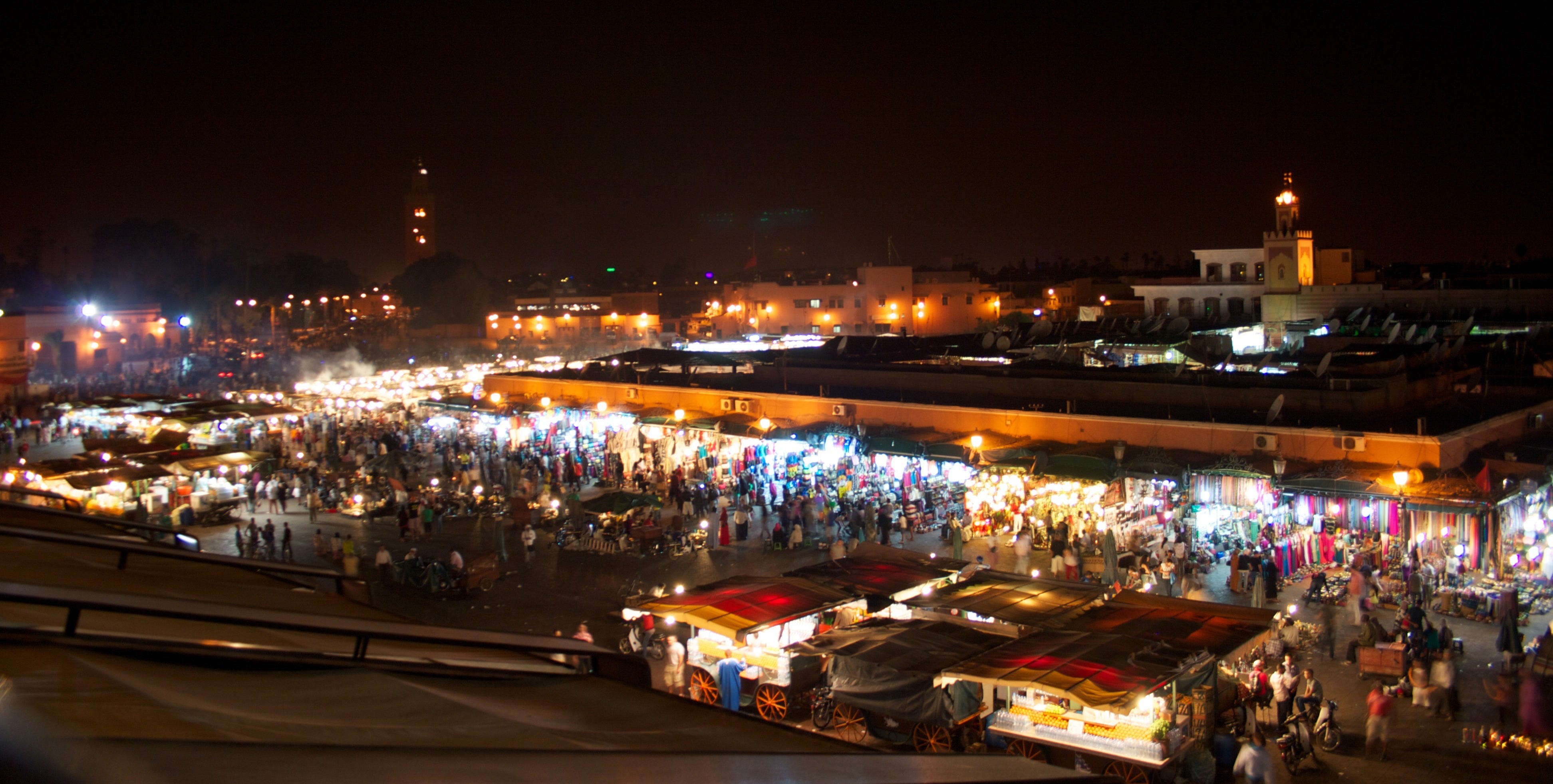
Narrowly missing a man with a giant tray of peanuts, I followed my buddy and a German traveler we’d just met into a wall of people. Jamaa el Fna eats you whole. Boiled snails in one corner, snake charmers in another, a man selling genuine Berber rugs to a couple who looked like they’d never bargained for anything in their lives.
I caught myself staring at the snails. The smell was sharp, garlicky, pulling me sideways. But we hadn’t found a place to sleep yet, and that takes priority over appetite no matter how good something smells.
My buddy cut through two back alleys, ducked down a small entrance, and stopped at a big metal gate. He went inside. I waited with the bags.
Cats circled me. Marrakech has more cats than people. Or at least it feels that way when you’re standing still with luggage in a city that rewards movement.
A few minutes later his head appeared. “Good news and bad news. Dorm’s full, but they have a hookah room on the top floor they’ll let us use.”
I said yes before he finished the sentence.
The hostel was Riad Layla Rouge. We dropped our stuff, changed shirts, and went back out. The German guy led us to a spot where we met a Basque girl heading to Marrakech to meet her boyfriend. We ate lamb sausages and rice at a food stall in the bazaar. She ordered for everyone in French and Arabic. I contributed nothing to the ordering and everything to the eating.
After dinner we wound up in a tea house on the edge of the square. Mint tea, the kind that’s more sugar than leaf. We sat on the terrace watching boys throw helicopter spinners thirty feet into the air and catch them on the way down. Nobody was filming it. Nobody was trying to make it go viral. The kids were just playing.
I pulled out my laptop to check in on Foursquare. I know. But there’s something about checking in somewhere you might never be again. It’s not for the audience. It’s for you. A digital notch in the belt.
I posted, closed the laptop, and went up to the terrace to sleep under the stars.
The next morning we headed out with a Portuguese traveler we’d met at the hostel and her friend. No plan. No route loaded. No list of must-see spots. Just four people walking toward whatever came next.
We bought bus tickets to Essaouira for the following day, then wandered toward Jardin Majorelle. Blue buildings, nice plants, exactly the kind of thing that photographs well and feels small in person. The girls had already been through it by the time we arrived. No loss. If I’m choosing between taking pictures in a garden and getting lost in a city, I’m choosing the city.
Three blocks from the garden we found a food cart selling camel sausages. My German friend bought three for me without asking. I ate all three walking down the street. They tasted like slightly gamier lamb. No menu. No review consulted. Just a man with a cart and some meat and the decision to trust him.
We ended up at the Ben Youssef Madrasa. A woman in front of me dropped an order of ten names to be written in Arabic calligraphy. I wanted one done but couldn’t wait. A few days later in Fes I found my name carved in stone by a stonemason working in an alley I walked through by accident.
You can’t plan that kind of thing. You can only be available for it.
The medina forces something on you. Not “forces” in a dramatic sense. Forces in a practical one.
You can’t navigate by screen in a place where the streets don’t have names your phone recognizes. Google Maps added offline mode in late 2012, about eight months before this trip, but offline maps in a medina are about as useful as a paper map in a hurricane. The alleys fork. They dead-end. They open into courtyards you didn’t know existed and close behind you like they never happened.
So you navigate by landmark. By smell. By the direction the crowd is moving. You ask people, and they point, and you walk, and sometimes you end up where you wanted to go and sometimes you end up somewhere better.
This is not romantic inefficiency. It’s a system that works because it assumes you don’t know what you’re doing and builds human assistance into every corner. The man selling hashish who followed us for three blocks was annoying, but the old man who lent my buddy his phone to call the hostel was the opposite. Both of them were part of the same network. The one where strangers are nodes.
Meanwhile I had a phone with Foursquare, a Jambox speaker I was carrying around like a lunatic, and GPX tracking running constantly so I could map my walks later. More technology in my pocket than the entire medina’s infrastructure, and none of it helped me find a bathroom at 11pm.
I think about that trip a lot. Not because Morocco was special, although it was. Because the way we moved through it is becoming impossible.
Not harder. Impossible.
Not because the medinas have changed, although some have. Not because people have stopped helping strangers, although fewer do when everyone has a phone. Because the expectation has shifted. You’re supposed to know where you’re going. You’re supposed to have a reservation. You’re supposed to have a plan.
A friend told me last month she won’t visit a restaurant without checking reviews first. Not bad reviews. Any reviews. No reviews means no data, and no data means risk, and risk is something the phone was supposed to eliminate.
The medina didn’t eliminate risk. It managed it with people. The guy at the tea house who told us which alley to avoid after dark. The hostel owner who walked us to a taxi stand instead of just pointing. The baker who sold us bread for 10 dirhams and threw in a second one because we looked hungry.
These weren’t services. They were just what happened when you showed up without a plan in a place that runs on being present.
The sunset from the terrace of Riad Layla Rouge that first night was better than anything I’ve seen on Instagram. No filter. No caption. Nobody else watching except the cats and the call to prayer.
I’ll take that over a geotag any day.