

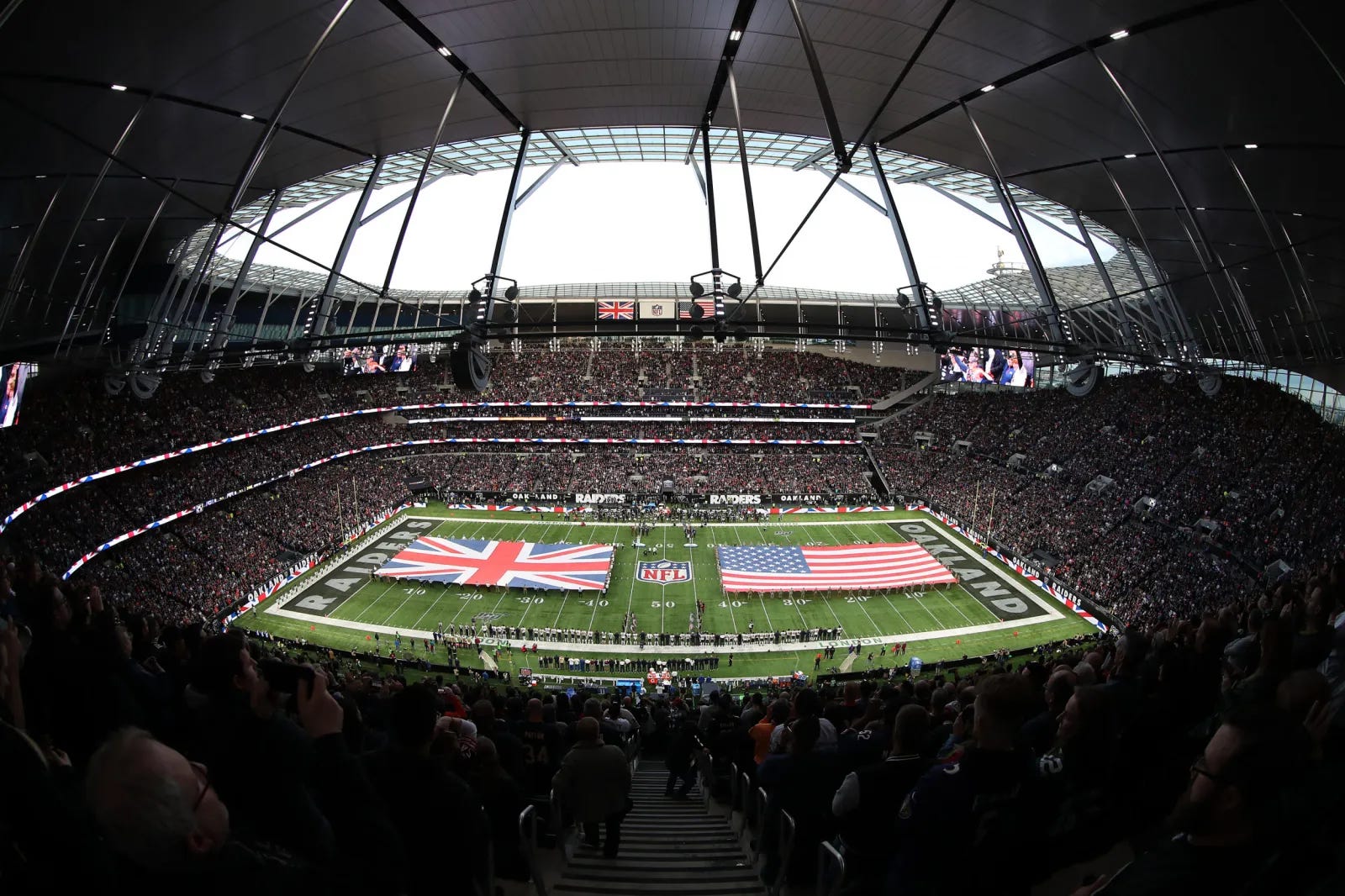
For years, the National Football League has been in a quiet, persistent campaign to grow—not just in revenue, but in reach. It wants an 18-game season. It wants 14 playoff teams. And, most intriguingly, it wants to plant its flag far beyond American soil. On the surface, these look like separate initiatives. But if you listen closely to the owners, a deeper strategy emerges—one that isn’t just about adding games, but about reshaping what the NFL can be.
In 2014, Dallas Cowboys owner Jerry Jones offered a clue. Speaking about the Buffalo Bills’ future, he didn’t talk about wins and losses. He talked about the pie.
“We always ought to be looking for ways to improve not only the growing the pie,” he said, “but also growing the fan base.”
That’s the crux of it. The NFL dominates American sports, but its growth at home is reaching a ceiling. To expand the pie, the league must look outward—internationally. And that means confronting a delicate question: If you’re going to invite new cities to the table, what do they bring to deserve a slice?
The answer is unfolding in slow motion, through a series of likely franchise relocations that aren’t just about unhappy teams, but about deliberate market expansion.
San Diego to Los Angeles is the safe, domestic move. A stadium in decline, a ready-made market, an existing fanbase. It’s a logistical shuffle, not a leap.
Oakland to Mexico City, however, is a different proposition. In 2005, the NFL staged a game in Mexico City that drew over 103,000 fans—a record at the time. The league shifted its gaze to London soon after, but the potential south of the border never faded. With a massive, stadium-ready city and a reported 25 million-strong Hispanic fanbase already engaged, Mexico isn’t just a market—it’s a statement.
Then there’s Buffalo to Toronto. Since 2008, the Bills have played multiple “home” games in Toronto, pulling thousands of Canadian fans across the border. But here’s the catch: in Toronto, the Bills aren’t even the most popular NFL team. This creates a chicken-and-egg problem. Fans gravitate toward winners, but a winning team is less likely to move. Toronto may get a team—but probably not until it wants one badly enough to embrace a franchise through its lean years.
Which brings us to the boldest, most unlikely, and most revealing possibility: Jacksonville to London.
The NFL has been patiently courting London for over a decade, first with NFL Europe, then with the International Series. The Jacksonville Jaguars have become London’s adopted home team, playing annual games at Wembley to sold-out crowds. The logistics are daunting—an eight-hour flight, a five-hour time difference. Monday night games in the U.S. air at 1:30 a.m. in London. And yet, the league keeps investing. Why?
Because London isn’t just a city. It’s a gateway. A team in London wouldn’t just capture British fans—it would broadcast the NFL across Europe, creating a new continent of viewers, merchandise sales, and television deals. The risk is enormous. But so is the reward.
There’s just one problem: you can’t ask athletes to routinely fly across the Atlantic without a structural concession. And that’s where the NFL might borrow a surprising idea from college football: the “Hawaii Exemption.”
In the NCAA, teams that travel to play in Hawaii or Alaska are allowed an extra game—or an extra bye week—to offset the brutal travel. It’s a scheduling accommodation for geography. If the NFL placed a team in London, it would need a similar rule: maybe an extra bye week after an international trip, or a subtle realignment of the schedule to allow for “road stretches” abroad without crippling jet lag.
This isn’t just hypothetical. It’s the missing piece that makes international expansion feasible. And it helps explain the league’s other moves.
Take the push for 14 playoff teams. On the surface, it’s about adding more games, more TV revenue, more fan engagement in two extra cities each January. But look deeper: expanding the playoffs now prepares the league for a larger future. If you add teams in London or Mexico City, a 14-team playoff field keeps the odds of inclusion fair—and keeps new fans hooked. You don’t build a two-bedroom house if you plan on having five kids. You build for the family you intend to become.
The same goes for the 18-game season. An extra game isn’t just another broadcast slot. It’s flexible currency—something to trade with the players’ union for those crucial bye weeks after international travel. It’s a way to make London or Mexico City feasible without burning out the athletes.
The timeline is already in motion. The current collective bargaining agreement runs through 2021. The Jaguars’ Wembley commitment extends through 2016. The Bills are for sale now. We are, in effect, watching the NFL test the waters—domestically in L.A., cautiously in Toronto and Mexico, and ambitiously in London—before deciding how big the pie can really get.
In the end, this isn’t just about football. It’s about logistics, leverage, and long-term ambition. The NFL is no longer just an American league wondering if it can go global. It is methodically, quietly engineering the conditions to make it possible. The moves on the board—the playoffs, the season length, the franchise relocations—are all connected. They are steps in a single, patient play to redraw the map of professional sports.
And the world, it seems, is watching.