

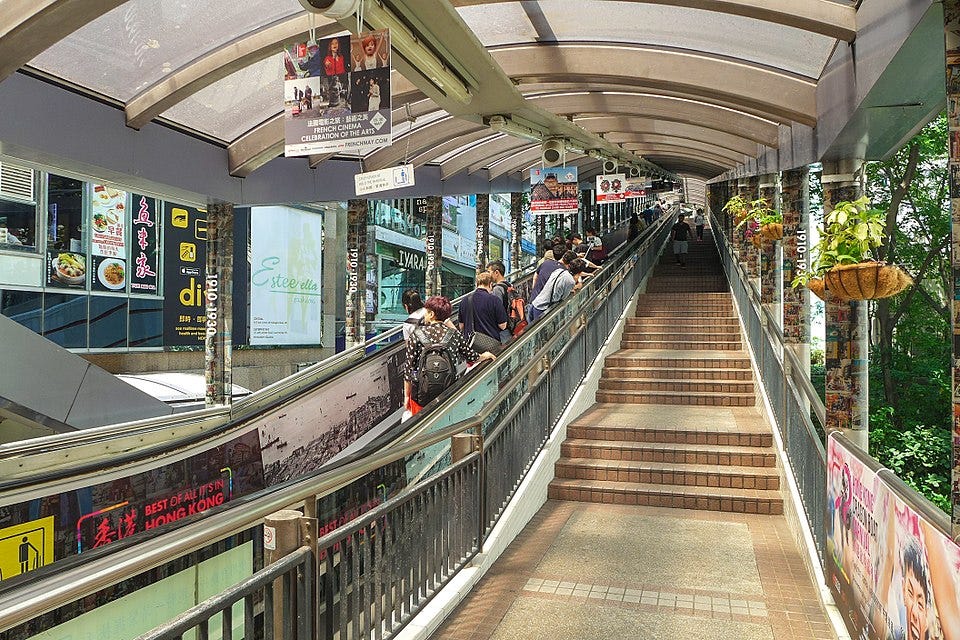
There's an escalator in Hong Kong that runs for 800 metres uphill through the middle of a city. It starts in Central, the financial district, and it climbs through Soho, past restaurants and bars and apartment buildings, up into the Mid-Levels where the expats and the wealthy locals live. It takes about twenty minutes to ride the whole thing. It's the longest outdoor covered escalator system in the world, and it was built in 1993 to solve a simple problem: too many people trying to walk uphill in the heat.
I ride it almost every day. Not because I live in the Mid-Levels. I don't. I ride it because the neighbourhood it passes through is the most efficient classroom I've ever sat in.
Business school teaches you frameworks. Porter's Five Forces. SWOT analysis. The BCG matrix. You learn to categorise problems into quadrants and apply models that someone else built for a different situation twenty years ago. The frameworks are clean. The spreadsheets balance. The case studies have endings.
Hong Kong doesn't work like that.
The escalator passes through maybe fifteen different economic zones in twenty minutes. At the bottom, in Central, you've got the glass towers. HSBC, Bank of China, Standard Chartered. The air conditioning blasts out of every lobby. Men in suits walk fast and don't look up. This is the Hong Kong that the Economist writes about. Finance. Capital. The free market at work.
Ride up three minutes and you're in a different country. The buildings get shorter. The shops get smaller. A woman is hanging laundry on a bamboo pole that sticks out over the escalator. Below her, a man is gutting fish on a stainless steel table on the pavement. The fish came from the wholesale market at 4am. He'll sell it by noon. The margins are thin and the hours are brutal and he's been doing it for thirty years because his father did it before him. Nobody taught him Porter's Five Forces. He knows which fish sell on Tuesday and which sell on Saturday. That's his framework.
Keep riding. The restaurants start. Not the ones with Michelin stars, though those are nearby. The ones with plastic chairs and laminated menus and a cook who does one dish, maybe two, and does them so well that people queue at the door. A noodle shop. A congee place. A dai pai dong that's been operating out of the same metal stall since 1978. The woman who runs it is sixty-something. She doesn't have a website. She doesn't need one. Her marketing strategy is a pot of broth that's been simmering since yesterday.
This is what the escalator taught me that business school couldn't. Not because business school is bad, but because business school teaches you to think in systems, and the escalator teaches you to think in people.
The escalator was a government project. That’s the first thing that surprised me. Hong Kong, the poster child for free-market capitalism, built a public escalator to help commuters get uphill. The logic was straightforward. Traffic was bad. The streets in Central are narrow and steep. Buses couldn’t handle the grade. Walking in 35-degree heat with 90% humidity was miserable. So the government built an escalator.
The cost was about HK$240 million, roughly US$30 million at the time. For a piece of public infrastructure, that’s nothing. A highway interchange costs ten times that. But the escalator didn’t just move people. It created a neighbourhood. Before the escalator, the area between Central and the Mid-Levels was a dead zone. Steep streets, old buildings, not much reason to stop. After the escalator, the foot traffic multiplied. Restaurants opened. Bars followed. Property values along the route climbed. Soho, south of Hollywood Road, became a destination
Nobody planned this. The government built the escalator to solve a commuting problem. The market solved everything else. Call it a libertarian argument if you want. What actually happened is simpler: you remove a friction point, and humans do what humans do.
The escalator didn’t build a neighbourhood. It removed a hill. Everything else was already there, waiting.
There's a timing thing the escalator does that most people don't notice. In the morning, it runs downhill. Commuters in the Mid-Levels ride it down to Central for work. In the afternoon, after 10am, it reverses. It runs uphill. The direction flips based on when people need it.
I find this fascinating because it's the opposite of how most infrastructure works. A road doesn't change direction. A train runs on the same track both ways, but the schedule is fixed months in advance. The escalator just flips. It adapts to the flow instead of forcing the flow to adapt to it.
A product person would recognise this immediately. The escalator was designed around user behaviour, not around the engineering. The engineers could have built two escalators, one up and one down, and called it done. That's the obvious solution. Instead, they built one and reversed it. Half the cost. Same outcome. Better, actually, because it concentrated foot traffic in one direction at a time, which made the street-level businesses more predictable.
This is the kind of decision that doesn't show up in a case study because it looks too simple. Where's the five-forces analysis? Where's the competitive advantage? There isn't one. There's just someone who watched how people walked and built accordingly.
Hong Kong is in a strange place politically right now. The Umbrella Movement happened a year ago, in late 2014. Occupy Central shut down major roads for 79 days. The city is still processing what happened. Conversations about democracy and autonomy and Beijing's influence are everywhere, if you know where to listen.
The escalator doesn't care about politics. It just runs. Up in the morning, down after 10am. The woman at the dai pai dong doesn't care about politics either, at least not during service hours. She cares about whether the broth is hot and whether the noodles are right. The fishmonger cares about his margins. The bar owner in Soho cares about whether the expats will come back tonight.
Business school teaches you to think about markets as abstract systems. The escalator teaches you that markets are people, and people have other things on their mind besides markets.
I'm here for work. Advertising. Digital. The kind of work where you sit in a glass room and talk about "engagement" and "reach" and "consumer behaviour" while the actual consumers are downstairs, on the escalator, going somewhere that has nothing to do with your campaign.
The escalator humbles me. Not in a dramatic way. In a slow way. Every day I ride it and see something that contradicts something I've been taught. A business that shouldn't work, working. A strategy that shouldn't scale, scaling. A shop with no sign that had more repeat customers than anything in my portfolio.
The escalator breaks sometimes. It’s old. The mechanical parts wear out. When it stops, people walk. They complain, sure. Hong Kongers complain about everything. But they walk. The street doesn’t die when the escalator stops. It just gets harder.
I think about this when I see startups panic about downtime. Your server goes down for an hour and you lose your mind. The escalator goes down for a week and the restaurants keep cooking. The fishmonger keeps gutting. The dai pai dong keeps simmering.
Infrastructure matters, but it’s not the business. The business is the broth. The business is the fish. The business is the woman who knows your order before you sit down. The escalator is what gets people there. If it stops, they find another way.
That’s the MBA lesson, if there is one. Don’t confuse the infrastructure with the value. The value is the thing people come back for. Everything else is how they get to it.
I'll leave Hong Kong eventually. Go back to Beijing. But the escalator will stick longer than anything I learned in a classroom.
It's an escalator. It goes up and down and it breaks sometimes and people ride it because it's there and it's easier than walking. Nothing more.
But it's teaching me to watch before I strategise. To see how people actually move, not how I think they should move. To build for the flow, not against it. To understand that the best infrastructure disappears. Nobody on the escalator is thinking about the escalator. They're thinking about lunch, or getting home, or the meeting they're late for. The escalator just lets them think about those things instead of the hill.
That's what good technology does. That's what good anything does. It removes the hill and lets people get on with it.