

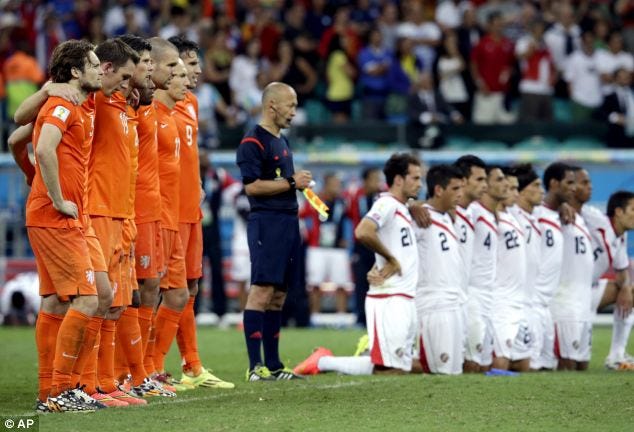
You hear it in a bar in New York: “What’s the point if it can just end in a tie?” You hear it in a pub in London: “They fought hard and earned a point with a late equalizer.” The same word—a “draw”—is a mark of shame in one culture and a respectable result in another. This isn’t just a difference in sports. It’s a fundamental disagreement about what a game is supposed to do for us. What, exactly, constitutes a perfect ending?
In America, a sporting event is a contract: we invest our time, energy, and emotion, and we expect a definitive resolution. A verdict. This cultural insistence was laid bare in the summer of 2002, during the Major League Baseball All-Star Game. By the 11th inning, the teams were tied, 7-7. Players were exhausted; pitchers were running dry. Commissioner Bud Selig, facing a dilemma no one had anticipated, made a historic decision: he called the game. It was over. A tie.
The reaction was not quiet disappointment. It was outrage. Beer bottles rained onto the field. The sports talk radio circuits burned for days. In a league famously resistant to public pressure—remember, this is the institution that banished Pete Rose—the backlash was so profound it forced a permanent change. MLB decreed that the All-Star Game would never again end without a winner. More strikingly, they attached a monumental consequence to it: the winning league would get home-field advantage in the World Series. A mere exhibition was transformed, by the sheer force of American aversion to the tie, into a high-stakes battle.
The message was clear: even in a friendly spectacle, the American public demands a winner and a loser. There must be closure.
Two years later, Gary Bettman, commissioner of the National Hockey League, faced a similar crisis. The league was emerging from a bitter lockout; its relationship with fans was fractured. Bettman needed a gesture that would signal change, something to lure back casual viewers. He introduced two revolutionary rules: he eliminated the restrictive “two-line pass” to speed up the game, and he declared that no regular-season game could ever end in a tie.
The new overtime procedure was simple and brutal: a five-minute, sudden-death period. If that failed, a shootout—a gladiatorial one-on-one between shooter and goaltender. Every night would now deliver a victor.
Traditionalists grumbled. But Bettman understood a crucial truth: for the non-devotee, a tie feels like an unfinished story. The shootout provided a guaranteed, cinematic finale. Fans returned. In the following years, the NHL grew not just in its traditional heartlands, but in sunbelt cities where the sport had always struggled. The lesson? A guaranteed result is a powerful engine for fan engagement.
But here’s the counterpoint from the football-loving world: isn’t the beauty of the game often found between the goals? A deft through-ball, a perfectly timed tackle, a player dribbling past two defenders—these moments provide joy irrespective of the final score. The pleasure is in the craft, the sustained narrative of the match. The draw, in this view, is a fair and logical conclusion to a complex battle*
So we have two models: the American demand for finality, and the European appreciation for process.
Which system is better? To answer that, we must consider what happens when the stakes are absolute—when a tie is not an option.
Consider the 2009 Big East tournament basketball game between Syracuse and Connecticut. After 40 minutes, they were tied. They played on. And on. Six overtimes. Three hours and forty-six minutes. When Syracuse finally prevailed at 1:22 AM, the players were not just exhausted; they were physically diminished. The human body, even at its peak, has a ceiling. Coordination declines, energy fades. This is the hidden cost of the “play-to-a-finish” ideal: the quality of the spectacle itself can deteriorate.
This is where football’s wisdom shines. The players are in near-continuous motion; the pitch is vast. Extending such a game indefinitely would be not just grueling, but counterproductive. The 90-minute limit is a recognition of human physiology. A draw, and the shared point, is a rational concession to reality.
Hockey found a brilliant hybrid. It kept the European-style points system (a point for a tie after regulation), but added the American-style resolution (overtime and shootout for a second point). It respected the battle while satisfying the need for a winner. And crucially, when the games matter most—in the playoffs—the shootout is abandoned. Teams play unlimited, sudden-death overtime periods. The resolution must come from the flow of the game itself, not a skills competition.
This presents us with a fascinating principle: The optimal ending depends on the context.
For a regular-season contest, where the goal is to maintain engagement across a long campaign, hockey’s model is masterful. It offers fairness (the shared point) and excitement (the guaranteed winner). It’s the reason the NHL recovered from its crisis.
For a knockout tournament or playoff, where legacy is decided, football’s World Cup model is ideal: extended, continuous play until a golden goal. It preserves the essence of the sport under maximum pressure.
Baseball, with its limitless innings, and basketball, with its repeated overtimes, honor the American insistence on a gameplay verdict, but they risk pushing athletes beyond their optimal performance window.
The British fan may scoff at American sports with their substitutions and breaks. But those structures allow for the marathon contests we cherish. The footballer, running relentlessly on a vast field, cannot be asked to do the same.
In the end, the “perfect” ending isn’t one thing. It’s a negotiation between culture, physiology, and narrative. The tie is not an insult; it’s a different kind of conclusion. And the shootout is not a corruption; it’s a tool for renewal. What we choose reveals what we want from the game: a clean verdict, or a shared story. Perhaps the greatest systems are those, like hockey’s, that find a way to give us both.\