

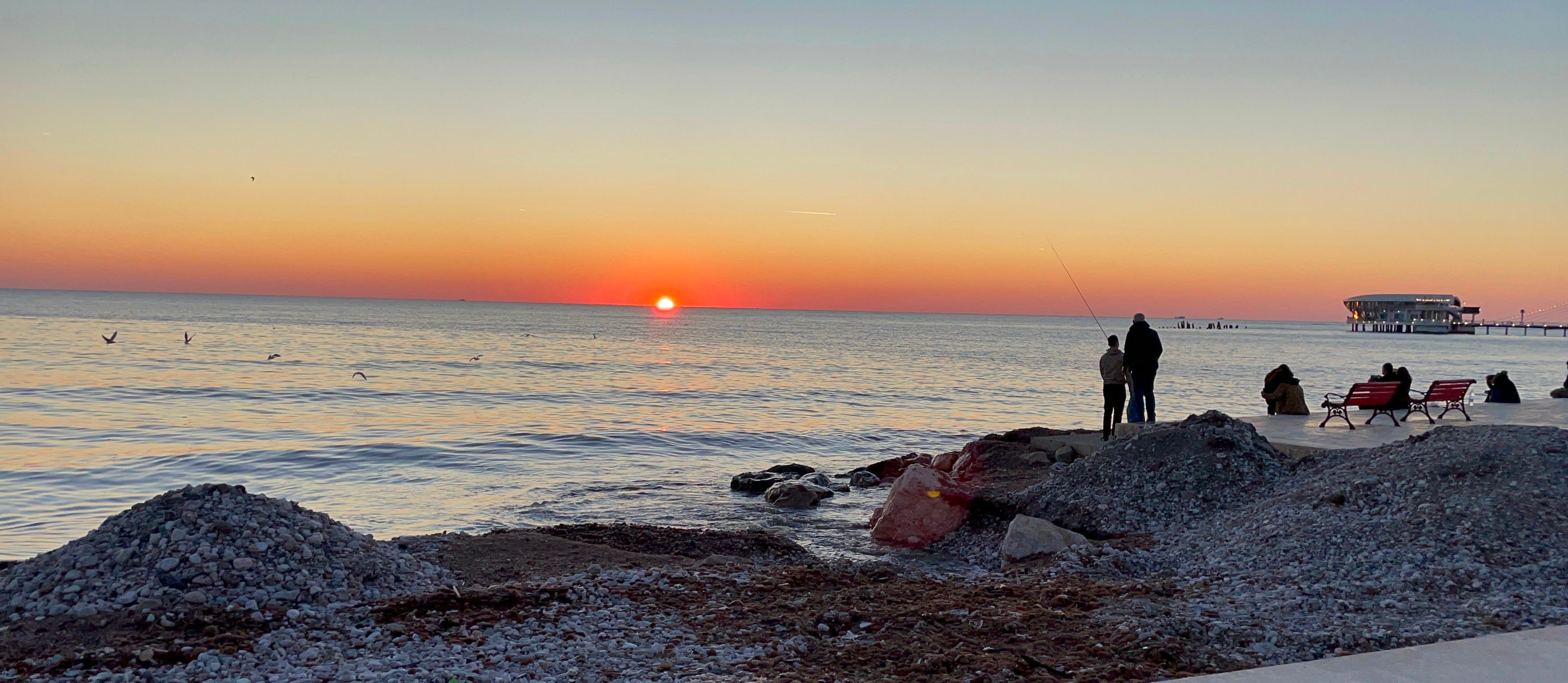
Bari in early November is still warm enough to eat outside. The old town is a maze of white stone alleys where laundry hangs between buildings and old women watch you from doorways. I sat at a plastic table in a piazza that had been a marketplace since the Normans, eating octopus that cost eight euros, and tried to book a bus to the south.
The website asked for a codice fiscale. I didn't have one. I wasn't Italian, didn't live in Italy, wasn't staying long enough to qualify for anything. The form wouldn't proceed without it. No field for passport number, no "foreign tourist" checkbox. Just a mandatory 16-character tax code that would take three days to get from the Agenzia delle Entrate if I knew where to queue.
I switched to Trenitalia. The app offered me regional trains to places I couldn't pronounce, with transfer times that looked like someone had generated them randomly. Lecce, three hours. Brindisi, four. The prices were fixed, the routes were ancient, and the whole system ran on infrastructure decisions made when Italy was still a kingdom.
I gave up and walked back through the old town. The octopus was good. The frustration was familiar.
A week later I was in Albania. I crossed the border in a car with someone who knew the roads, but the difference wasn't in the driving. It was in the phone.
The SIM card cost five euros at a kiosk in Shkodër. No forms. No waiting. The guy activated it while I stood there, handed me back my phone with data already working, and waved me away. I walked out with 50 gigabytes and a local number, connected to the network within ninety seconds of hitting the street.
In Bari I'd spent an hour fighting a bus website. In Albania I had a working phone before I finished buying it.
This is not a small difference.
Albania in 2024 is a country that got a second chance at the twentieth century. The first attempt ended with bunkers, isolation, and a pyramid scheme that collapsed the economy in 1997. Every hillside still has concrete mushroom domes left over from the Enver Hoxha era, thousands of them, built to defend against an invasion that never came. The infrastructure from that period is mostly abandoned or repurposed.
The infrastructure from the 2020s runs on fiber. The country laid gigabit internet across most of its territory in less time than it takes Berlin to approve a new tram line. Mobile coverage in the mountains is better than it is in the London tube. The reason is simple. There was no legacy system to upgrade. No copper network to maintain, no state monopoly to dismantle, no decades of underinvestment to undo. When Albania needed internet, it started from scratch.
Starting from scratch is a superpower. Most of Europe can’t do it.
The Bari trip was November 3. I took photos of the basilica, the harbor, the street where my Airbnb was. The photos are fine. The city is beautiful. But what I remember most is the friction. Every transaction felt like it was happening through a layer of older systems. Cash was still the default at smaller shops. The bus app required the tax code. The train system assumed you were Italian, lived in Italy, and had all the documents. Nothing was built for someone passing through.
Italy has layers. Roman roads under medieval streets under 19th-century buildings under post-war apartment blocks. The digital infrastructure is the same. SIP existed before TIM, which existed before the current mobile providers. The banking system predates computers. The tax code predates the internet. Every new system has to sit on top of the old ones, which means the old ones never really go away.
Albania skipped those layers. The country didn’t build a landline network and then upgrade to mobile. It went straight to mobile. It didn’t build a desktop banking culture and then add apps. It went straight to apps. In 2010, only 46% of Albanians had used the internet. By 2024, mobile broadband subscriptions covered 95% of the population. The leap didn’t take twenty years. It took ten.
I spent November 16 walking through Tirana. The city is loud, dusty, and building itself at a pace that feels frantic. New apartment towers next to faded communist blocks. Glass-fronted co-working spaces across from shops selling baklava from tin trays. Everything is under construction. Nothing has finished settling.
I went to Bunk’art, the underground Cold War museum built inside a nuclear bunker under a hill in the middle of the city. Sixty-five rooms of tunnels, originally designed to shelter the communist elite during a war that would have killed everyone else. The exit spills you back into daylight next to a cafe with wifi and a QR code menu. The contrast is not subtle. It’s the same geographic space, forty years apart, running on completely different operating systems.
The bunker was built to protect the past. The cafe outside runs on the future. There is no middle ground. There was no gradual transition. The country just skipped from one era to the next, leaving the bunkers as monuments to a timeline that ended.
I don’t mean this as a techno-utopian take. Albania has serious problems. Corruption is endemic. The economy relies heavily on remittances from diaspora workers. The brain drain is real. The rule of law is uneven. The country was negotiating its EU accession while I was there, and the list of requirements is long and specific.
But the digital story is different. Digital adoption doesn’t care about institutional quality in the same way. It doesn’t require a functioning legal system, a transparent procurement process, or a stable bureaucracy. It requires a phone, a tower, and a SIM card. Albania had the advantage of arriving late, with nothing to unlearn.
The government digitized tax filing, business registration, and property records in a few years. Not because the administration was efficient. Because the alternative was the old system of queuing at counters, and the old system was broken beyond repair. Digital wasn’t a choice. It was the only option.
In Bari, I could not book a bus because I lacked a 16-character code created by a tax agency that predates the European Union.
In Tirana, I paid for a coffee by pointing my phone at a QR code taped to the counter. The transaction took four seconds. The barista didn’t look up.
This is not a boast about Albania. This is a measurement of what legacy does to a system. Every layer of history is a layer of friction. The question is whether the friction is worth the stability it provides. In Italy, the answer is yes, often enough. Old systems are reliable. They have decades of edge cases baked in. They are trusted.
But trust has a cost. The cost is the inability to start over.
Albania started over. Not because anyone planned it that way. Because the old thing collapsed, and nobody rebuilt it. The country had a decade of near-anarchy in the late nineties. It had a civil war that destroyed what little infrastructure existed. Then it had nothing. And nothing, it turns out, is the best foundation for a new build.
I need to be careful here. This could become a version of the "poor countries are lighter and more agile" narrative that romanticizes poverty. That's not what I'm saying. Albania is not poor in the way it was in 1997. It has a growing economy, a young population, and some impressive engineering. The internet is good because the people who built it knew what they were doing, not because the country was a blank slate.
But the blank slate helped. The absence of legacy systems meant the best solution was the newest solution, not the most compatible one. When you don't have to support a 30-year-old payment rail, you can adopt the one that launched last year. When you don't have a national ID system from the 1980s, you can build one on a mobile app. When nobody has a credit card, there's no reason to build a payment system that accepts them.
Europe's tech sector spends most of its energy on integration. Connecting new systems to old ones. Writing adapters. Maintaining backward compatibility. Albania doesn't have that problem because it never built the old systems in the first place.
I flew out of Tirana on a Sunday afternoon. The airport is small, modern, functional. There is a free, unmetered wifi network that doesn't require a login. It just works. In Berlin Brandenburg Airport, the wifi asks for your email, sends a verification code, logs you out after an hour, and makes you do it again. The airport cost seven billion euros and took fourteen years to build.
Tirana's airport was renovated in 2020 and handles passengers efficiently. The wifi is the proof. The airport built for the present. Berlin built for the past and half of the present, with a committee deciding every requirement.
This is the real difference between Bari and Tirana. Bari is beautiful and old and layered and constantly negotiating with its own history. Tirana is ugly and new and unfinished and moving forward because moving backward isn't an option. Both are valuable. But only one of them can build something from nothing.
I'm still thinking about that bus I never booked. I could probably find a way to get there now. There might be a workaround. There's always a workaround. But the fact that a workaround is necessary is the whole point. The system wasn't designed for me. It was designed for someone who lives there, who has the codice fiscale, who belongs to the history embedded in the code.
Albania's systems weren't designed for me either. But they didn't need to know who I was. They just needed to work.