

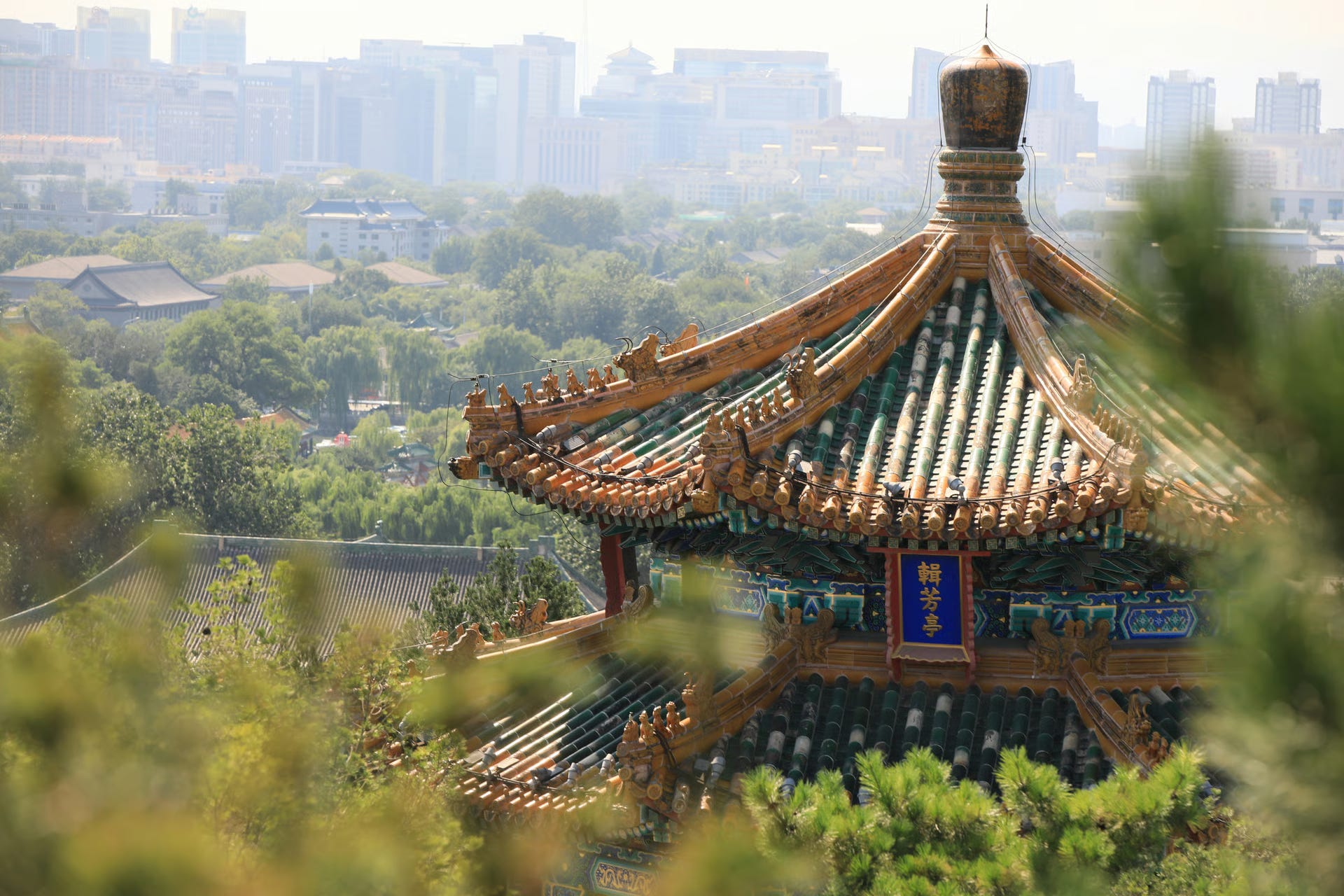
Beijing in winter is a grey inversion of every city you've known. The sky sits lower than it should. The cold bites differently. Not wet like London, not dry like the desert. Just present in a way that makes you remember you're wearing a body. The fourth ring road runs in a perfect square around everything, and inside that square, a billion and a half people are building something the rest of the world will spend the next decade catching up to.
I arrived in August 2013 with a backpack and a phone that didn't work. The phone part mattered more than I understood at the time.
You can't just drop a SIM into a foreign phone in China. Every handset is locked to a carrier, IMEI-registered, tied to a real name, a real ID, a real address. Getting connected takes two days of bureaucracy. In that window, you watch everyone around you living on their phones. Paying for noodles, hailing taxis, splitting bills, streaming video. And you realize you're the only person at the table who can't.
Nobody carries cash in Beijing. That's the first thing you notice.
A taxi ride in January 2014 taught me more about the future of money than any banking conference I'd sat through in London.
The driver didn't take my 50 yuan note. He pointed at a QR code sticker on his dashboard, a blue-and-white square the size of a postage stamp, and grunted. I didn't have the app. He shrugged and drove off. I stood on a frozen street in Zhongguancun, Beijing's tech district, with my useless cash and my useless foreign phone.
That QR code was the front line. Two companies were fighting over what money would look like, and the West had no idea the battle had started.
Two weeks earlier, on January 17, 2014, WeChat had launched digital red packets. A simple feature: send money inside a chat as a virtual hongbao, the red envelopes Chinese families have exchanged for centuries during Lunar New Year. The twist was the randomization. A group sender sets a total amount and a recipient count, and the app splits the money randomly between whoever grabs fastest. It turned gifting into a game.
Within a month, WeChat Pay went from 30 million users to 100 million. A 3x jump in thirty days. Users flooded the system, binding bank cards by the tens of millions just so they could grab virtual envelopes from group chats.
Jack Ma called it the Pearl Harbor attack on Alipay. He wasn't being dramatic. By the time Alibaba understood what had hit them, WeChat had already captured the most valuable asset in mobile: the habit of sending money to friends without thinking about it.
In Beijing's tech circles, people talked about it like a sports play. I sat in a coworking space in Wudaokou while a startup founder explained it to me in English that got faster and more excited the further he got into the story. "They didn't build a better payment system," he said. "They made payments feel like talking."
I thought about London. In London, contactless payments had just started appearing on buses. The limit was 20 pounds. People were still pulling out wallets at pub tills. And here, a messaging app had just onboarded more payment users in one month than most European banks had in total.
The phones themselves told a similar story.
I'd bought a Xiaomi Mi3 in late 2013 because it was cheap and available. 300 dollars, unlocked, with specs that matched the year's flagship Android phones. The screen was sharp. The battery lasted two days. MIUI, Xiaomi's custom Android skin, had features that Google wouldn't copy for years. Built-in call recording, dual app instances, a permissions manager that actually worked.
The phone cost less than a round-trip train ticket from Beijing to Shanghai.
Xiaomi started as a software company. They built MIUI first, on XDA developer forums, taking feature requests from a small community of enthusiasts and shipping updates every Friday. By the time they started making hardware, they had millions of users who already felt like co-creators. The Redmi, launched in July 2013 at 799 yuan, about 130 US dollars, was their answer to a question nobody was asking: what happens when you sell a phone that's good enough for the price of dinner for two?
In 2014, Xiaomi shipped 61 million phones. A 227% increase from the year before. They became the number one phone maker in China, beating Samsung. Globally, they hit third place, behind only Samsung and Apple.
I went to Xiaomi's headquarters in Qinghe once, a district on the northern edge of the city where the apartment blocks get older and the streets get quieter. A meetup. A room full of engineers and students, talking about MIUI themes and battery optimization. Nobody mentioned market share. Nobody mentioned Samsung. They talked about the phone like it was a hobby they happened to sell at volume.
The West couldn't name this. In 2014, the smartphone narrative was about premium vs budget. iPhone vs Android. Samsung vs the rest. Xiaomi fit none of those categories. They had built a good phone and priced it low because the supply chain allowed it. The factory that made the Mi3 also made phones for brands you'd heard of. Same workers, same supply chain, same Qualcomm chips. The difference was that Xiaomi didn't spend money on advertising, retail stores, or carrier subsidies. They sold online, in flash batches that sold out in minutes, treating scarcity as a marketing tool.
Walking through a Beijing electronics market in 2014, you could see both futures at once. Stalls stacked with local handsets that cost as little as 40 dollars. And next to them, a teenager pulling out a Mi3 to scan a QR code and pay for a bubble tea. The same phone, the same app, the same leap.
September 2014 was when China's internet economy announced itself to the world.
Alibaba listed on the New York Stock Exchange on September 19. The company priced at 68 dollars a share and opened at 92.70. By the close of the first trading day, it was worth 231 billion dollars, surpassing Amazon, Facebook, and Twitter combined. The IPO raised 25 billion dollars, the largest in global history.
I watched the livestream in a cafe in Gulou. The owner had put it on his TV, and half the room was watching. Young Chinese professionals who'd never bought an Alibaba share and probably never would, but were watching anyway because something had just happened that changed how the world saw them.
The IPO validated everything Beijing had been building. Alibaba's e-commerce machine sat on top of a stack that was already running: WeChat payments, Xiaomi's supply chain, the QR codes in every taxi, the app stores running on Chinese-only operating systems, the mobile-first generation that had never owned a desktop computer.
The night after the IPO, I walked through Nanluoguxiang, a hutong alley near the center of the city. The street was lit with red lanterns and neon shop signs. A group of students sat on the curb, each holding a phone, their faces lit by the same blue glow. Silent. Every thumb moving. Sending red packets, WeChat messages, sharing food delivery orders, scrolling Taobao results, swiping Dianping reviews. Every transaction was digital. Every interaction was mediated by a screen.
The same scene played out in any city that year. London had phones for calls and texts and the occasional Uber. San Francisco had Facebook and Twitter and maybe Venmo for pizza. Beijing had phones for everything else. The phone was the operating system of daily life.
I left Beijing in the spring of 2015, a year and a half after I'd arrived. The phone I'd bought for 300 dollars still worked. QR code stickers had spread everywhere. Taxis. Convenience stores. Street food carts. Subway vending machines. The donation box at a temple in the Fragrant Hills.
Back in London, the contactless payment limit had just been raised to 30 pounds. People were still arguing about whether it was safe to store your card details on a phone.
I never did send a WeChat red packet. But I still have the Mi3 in a drawer somewhere. The screen is cracked. The battery swells if you charge it too long. Every time I look at it, I remember the taxi driver who refused my cash, and the look on his face.
He was trying to tell me something. I didn't understand for another two years.