

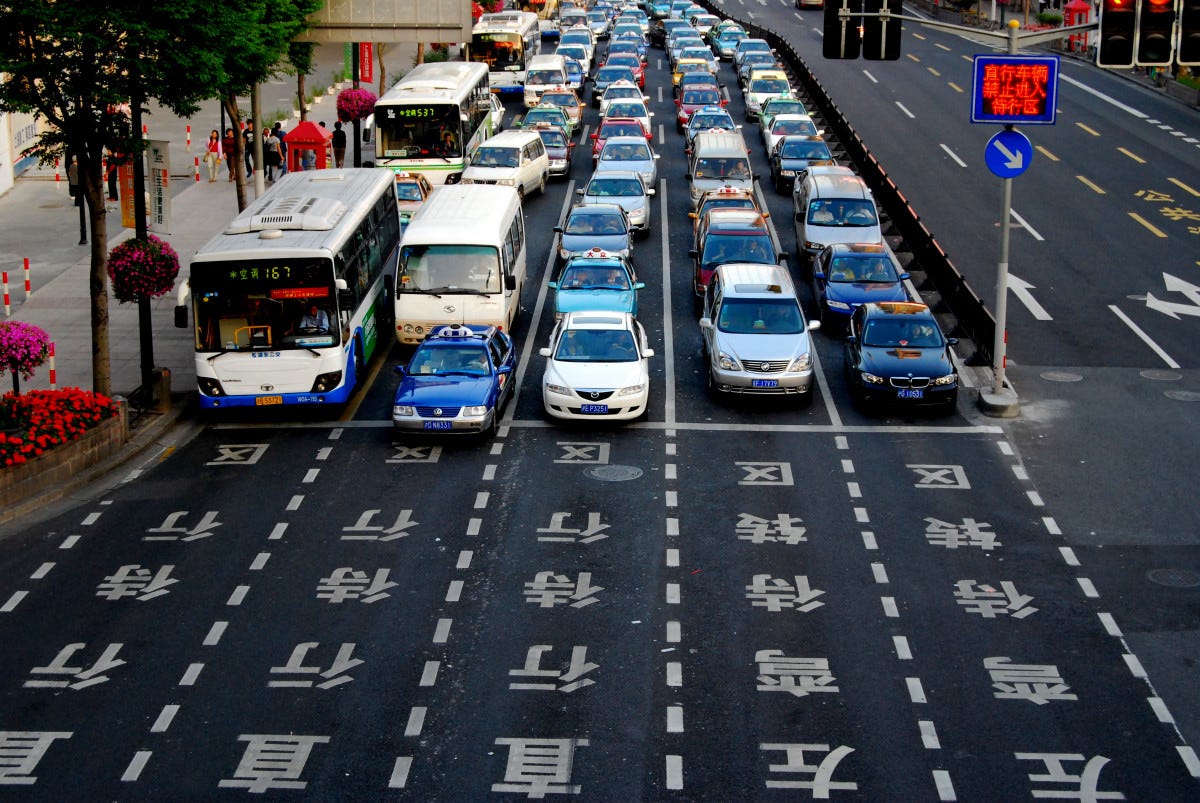
Cross a street in Beijing and the first thing you notice is that nobody is waiting for permission. The light changes and the crosswalk fills with people who were already moving before it did, e-bikes threading between them, a delivery scooter cutting the corner tight enough to clip a shopping bag. From outside, it looks like anarchy, though every person on that crosswalk, on foot or on two wheels or behind a windshield, is running a live negotiation with everyone else on the road, adjusting speed and angle by inches, reading intent off a stranger’s body language the way you’d read a hand of cards.
The driver who slows half a beat to let someone finish crossing gets something back for it. A hand raised. A short nod. Sometimes nothing more than eye contact held a second longer than it needed to be. I noticed it everywhere I went in Beijing, and it took a few days before I understood what I was watching. Each gesture worked as confirmation, sent in real time, that the exchange had gone the way both people expected: a stranger yielded space, and another stranger registered the yield.
That exchange holds up because the stakes on either side are not equal. A driver who misjudges a pedestrian loses time, or worse, and carries the blame either way. A pedestrian who misjudges a driver loses far more. Everyone on a Beijing street corner is running the same asymmetric calculation, thousands of times a day, and the nod is the cheapest way to confirm both people read it the same way. Repeat that calculation often enough, city-wide, and it stops looking like manners and starts looking like infrastructure, unwritten and running at a scale no single traffic engineer designed for.
A piece published this year in a Brazilian psychology outlet made the case that pedestrians who acknowledge drivers this way core higher on empathy and social awareness than the ones who don’t. The study behind that claim is thin, closer to magazine psychology than peer review, with no named researcher or data set attached. What survives the scrutiny is the underlying observation, not the six-trait packaging: the nod is a real signal, not a decorative one, and it’s doing measurable work in how the street functions.
China has started building tools that formalize this signal without replacing it. Amap, the navigation app owned by Alibaba, announced plans this year to export its AI-powered traffic light countdown feature to markets outside China, after rolling it out domestically since 2022 across nearly half a million intersections. The system doesn’t plug into a traffic light’s own hardware. Most cities don’t expose that access to a private company, and signal standards vary widely enough from place to place that a direct connection was never realistic. Amap predicts the signal instead, trained on years of historical timing and real-time vehicle flow, using a model the company calls visual spatiotemporal computing. What a driver or cyclist sees is a countdown, not a route handed down from above.
Amap is also one company, and Alibaba is not a small one. What separates it from the Cybercab is the role it plays, not whether an authority exists at all. Amap watches decisions that pedestrians, cyclists, and drivers already made, at half a million intersections, and turns the pattern into a prediction anyone can check against their own judgment. It doesn’t drive the car, and it doesn’t tell the pedestrian when to cross. The negotiation still happens between the humans on the street; the tool sits underneath it, sharpening everyone’s read on timing without ever taking the decision away from them.
Tesla’s Cybercab is not doing that. A passenger in Austin ordered a ride that Google Maps put at ten minutes and got a trip that took seventy, the car heading away from the destination for several miles before doubling back through the east side of town. The cause was structural. Cybercabs can’t use highways yet, so every trip gets routed through surface streets inside a geofenced area the company mapped in advance, and some riders report the cars avoiding railroad crossings on top of that. The car executed a path that someone else had approved months earlier, with no mechanism for noticing that a shorter one existed a block over, and no way to negotiate with the street underneath it. A double-parked truck, a closed lane, a faster route the map hadn’t been told about: none of that registers as information the car can act on, because acting on it was never part of the design.
Waymo, running in the same category, already allows highway driving in some of its cities, which is one reason its detours tend to be measured in minutes rather than the better part of an hour. The gap between the two companies comes down to how much of the route each one still insists on deciding in advance, and how much it lets the live situation on the ground revise, not full autonomy versus none. Elon Musk said, before any of this shipped, that a car needing a geofence doesn’t count as self-driving. The cars now on the road are proving his own line right, just not in the direction he meant it.
Beijing’s model carries a cost of its own. A visitor who hasn’t spent a week learning the local rhythm can misread a yield that isn’t there and step into a gap that was never open. The system depends on everyone staying alert in a way that a painted crosswalk with a legal right-of-way does not; look at your phone at the wrong second and the negotiation you’re relying on has no backup. That’s a weakness. Beijing’s failure mode is a distracted person missing a signal that was there. The Cybercab’s failure mode is a fixed plan with no capacity to notice a better signal even when one is sitting in plain sight, which is exactly what turned a ten-minute trip into seventy.
Trust spread across thousands of small, live negotiations scales in a way that trust concentrated in one company’s fixed map does not, at least for a problem that changes every few minutes and never looks the same twice. Beijing’s crosswalks are not orderly by the standards most Western visitors arrive expecting, and the city runs on a level of informal cooperation that reads as chaos for the first few days before it starts reading as consensus, rebuilt at every intersection, every few seconds, by whoever happens to be standing at the curb. A Cybercab with a static map of a few dozen approved blocks in Austin has none of that. It has a route someone decided was correct months ago, and seventy minutes to prove them wrong.