

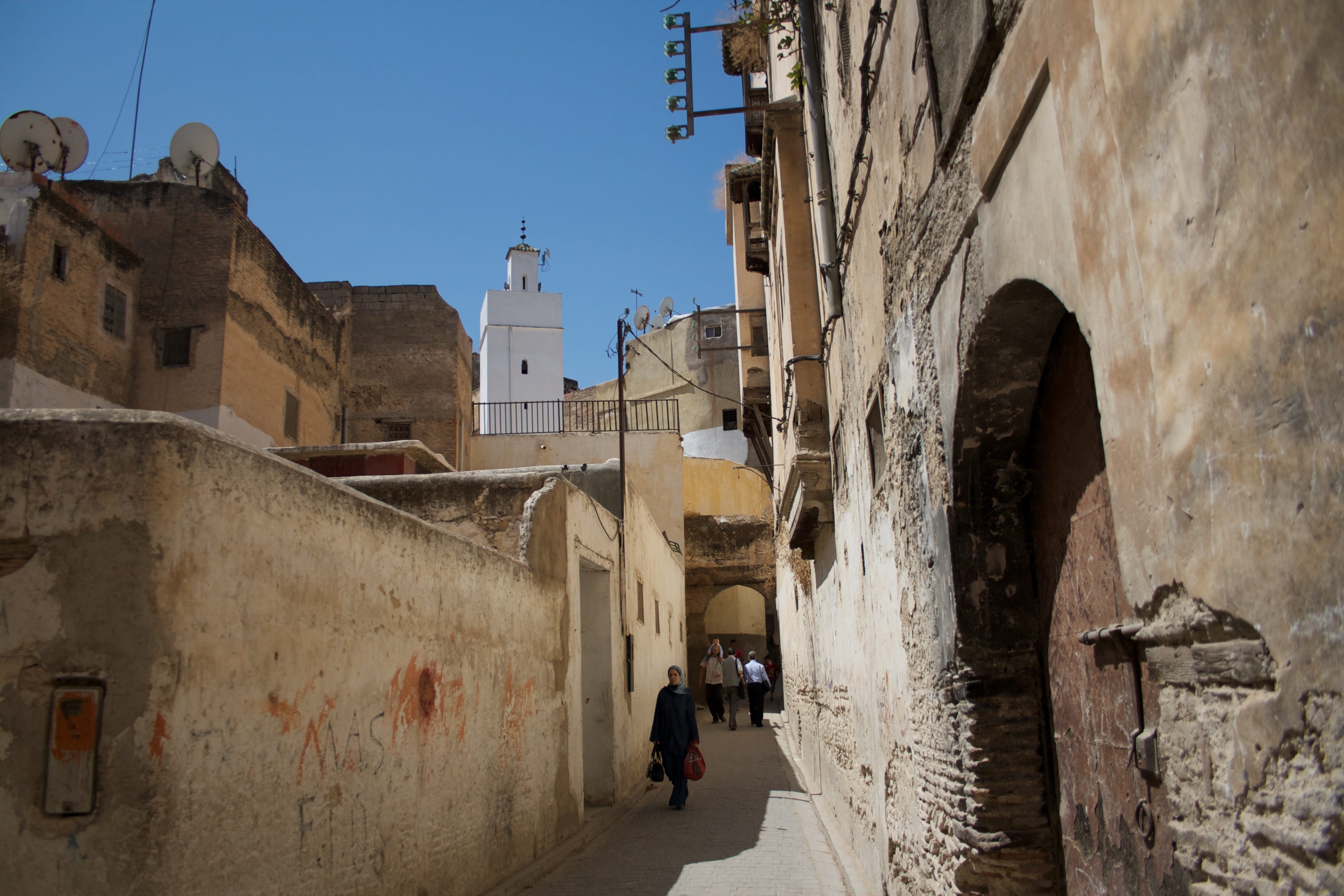
Almost nobody in the Marrakech medina has a street address. Not a bad one. None.
I found that out the useful way, standing in a derb off Souk Semmarine with a torn slip of paper and a man explaining that the shop I wanted was past the fountain, then right at the stall that sells nothing but hinges, then up the stairs behind the blue door that doesn’t face the alley. Past the hinges. Right, then up. That was the entire address. (The blue door part is real. Half the doors in there are described by the direction they refuse to face.)
You can wander that maze for an hour and still come out with exactly what you went in for, because the medina does not run on addresses. It runs on who does what.
The trade is the identifier. Nobody asks for the name of the man who repairs the brass. They ask for the man who repairs the brass, and get pointed toward the lane where the brass men have always been. The souks are zoned by craft and always have been. The dyers have their own stretch, the slippers have theirs, the lantern makers sit stacked in a row that has been the lantern row for longer than anyone walking it has been alive. The craft is the coordinate.
Above the trades sit the guilds. Each one has an amin, the head who settles disputes inside the craft and vouches for who belongs to it. Membership is not a certificate anybody prints. It is a position you hold, visible to everyone else in the trade, kept honest by the fact that your neighbours watch your work every morning.
Then comes the part that breaks every modern assumption about finding a person you have never met. A merchant will extend credit to a man he has never seen behind the counter, because he knows the family, or the mosque they both walk to, or the supplier who brought them together. The reputation travels by mouth and it stays specific. Not “trustworthy.” Closer to: pays on the tenth, argued fairly over the tile price in the spring, has not missed a delivery in nine years. Identity is social, local, and legible to whoever is standing near it.
That is the opposite of how we now try to let software agents find each other.
Every serious stack shipping this year is racing to build a registry. Model Context Protocol servers want discovery. Agent-to-agent protocols want an agent card so a stranger can read what a counterpart offers. Decentralised identity work wants a verifiable credential issued by an authority everyone agrees to trust. Underneath all of it sits the same assumption a Western planner makes walking into the medina for the first time: there has to be a central list, a canonical name, a numbering system everyone honours. Without one, the argument goes, agents will collide, spoof each other, and dissolve into chaos.
The medina is the counterexample. It has been running for about nine centuries.
It never had a registry. It never issued a number. What it had instead was context dense enough to stand in for one. You did not need to verify the hinge seller, because you were standing in the hinge lane, surrounded by people who would notice within a day if he stopped being the hinge seller. Trust was not global and portable. It was bolted to a place and a trade, and readable by anyone who walked up.
Now line that up against how agent infrastructure actually fails. Name collisions: two agents claiming the same identifier, with nothing local to arbitrate. Spoofing: a credential that is valid but unearned, because the issuer never has to look anyone in the face. Discovery that means nothing, because a registry can tell you an agent exists and still not tell you whether the last fifty people who dealt with it would deal with it again.
Registries answer one question and answer it badly: does this identifier exist. The medina answers the question that decides whether a transaction ever happens: is this the right person for the job, and who will vouch.
That is why the interesting work right now is not the largest database of agents. It is the plumbing that makes local trust legible to a stranger. Proving that this counterpart is the one your counterpart vouched for. Carrying a track record that travels without hardening into a score everyone learns to game. Letting a machine check the equivalent of the hinge lane before it moves the money.
None of this is tidy. The medina is slow, opaque to outsiders, and it would fall apart the moment the community holding it together stopped being a community. It survived anyway, because it put identity where identity gets used, next to the work, in front of the neighbours.
We will keep building registries. Some of them will earn their keep. The layer that wins will not be the one holding every agent’s name. It will be the one that lets a stranger walk into a strange alley, describe what they need, and get pointed at the right man.
Past the hinges. Right, then up.