

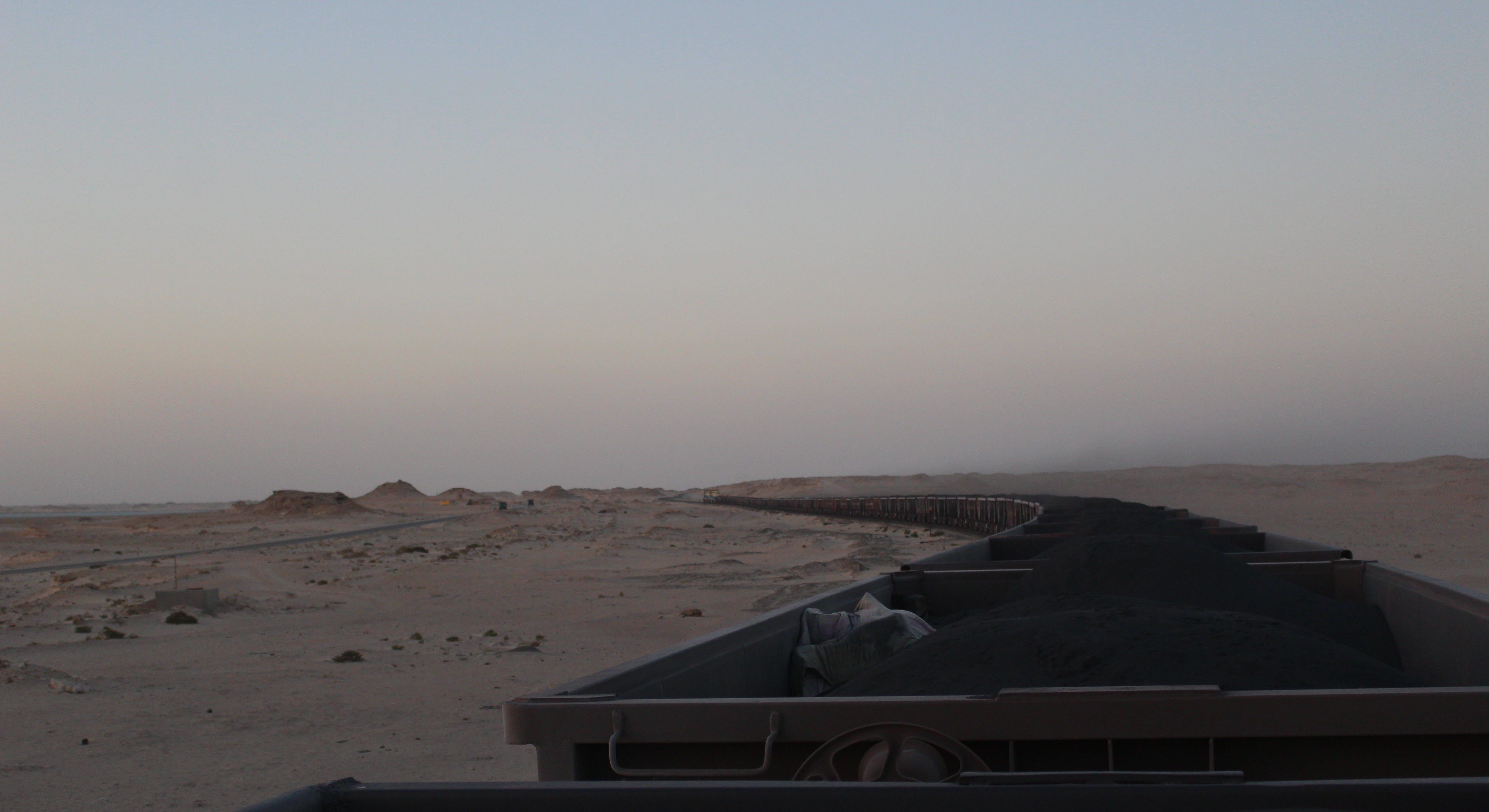
There is a train in Mauritania that does not run on a schedule. It runs when it is full. Sometimes that takes four hours. Sometimes it takes ten. The train is two and a half kilometres long, two hundred and twenty wagons loaded with iron ore. It has been making the same journey since 1963. Seven hundred kilometres from the mines at Zouerat to the port at Nouadhibou, across the largest hot desert on earth.
The engineers do not announce the departure. The station does not sell tickets. You find the train, you climb on, and you hope you have brought enough water.
I had been travelling through West Africa for about six weeks when I reached Zouerat. It is a mining town, seven hundred kilometres northeast of Nouakchott. There are paved roads and a few hotels that exist for company contractors. The airport exists for SNIM flights. The whole town exists for the iron ore mines. If you are there for any other reason, people look at you like you are slightly confused. And maybe you are.
Before I left Zouerat, a man I met at the hotel told me to bring oranges. Not a number. Not a kind. Just oranges. I asked him why. He just smiled and said I would understand. That is the kind of advice you trust, or you do not, and if you are in Mauritania you learn to trust it.
I bought a bag at a market stall the next morning. They were small oranges, a little dry on the outside, but they were oranges. I put them in my pack and I did not think about them again until the train came.
The train arrives without announcement. One moment the horizon is empty. The next, there is a low vibration coming through the ground. Then the locomotive appears, black and diesel, pulling three kilometres of iron ore behind it. The noise builds slowly and then it is everywhere. The wagons are open-topped, each one loaded with dark, fine-grained ore. You pick your wagon, you climb the ladder, and you find a spot on top of the cargo before the train starts moving again.
I climbed onto a wagon near the middle. The ore was soft under my feet, like walking on slightly damp sand. By the time the train lurched forward, the dust was already in my ears, my shirt, the corners of my eyes. You cannot keep it out. You stop trying.
There were four men already there, sitting in a hollow they had scooped out of the ore. The hollow was about two feet deep and maybe four feet across. It had taken them some time to dig. They had built a small fire in the bottom of it, using pieces of wood scavenged from somewhere. The wind kept threatening to put it out. One of them kept relighting it, patiently, without complaint.
They were cooking ramen.
I sat down on the edge of the hollow. I did not say anything because I did not know what to say. I took the bag of oranges out of my pack and held it out.
One of the men looked at me. He looked at the oranges. He took the bag, nodded once, and started peeling. He peeled each orange with the kind of precision that comes from having peeled thousands of them. He passed slices around the circle. When every person had an orange slice, he passed the rest of the bag around. Nobody asked my name. Nobody asked where I was from. I had oranges. They had noodles and a fire. Together, we had a meal that none of us could have made alone.
I have thought about that moment many times since I left Mauritania. Not because it was dramatic. It was the opposite of dramatic. It was quiet and simple and over in a few minutes. But it stayed with me in a way that the dramatic moments did not. And the reason it stayed, I think, is that it taught me something about how trust works that I had not been able to put into words before.
Here is what I mean.
When you contribute to an open source project, you are doing the same thing. You write a piece of code. You put it where other people can find it. You do not know who is going to use it. You do not know if they will contribute anything back. You trust that if the code is useful, someone will build on it. You trust that if it is broken, someone will fix it. You trust that the system will work even though no one is in charge of it.
That trust can feel abstract when you are looking at a pull request on a screen. But it is not abstract. It is the same trust that passes a bag of oranges around a fire pit dug into a pile of iron ore, in the middle of the Sahara, on top of a train that does not have a schedule. You contribute what you have. You trust that other people will contribute what they have. And somehow, the whole thing holds together.
Here is the part that surprised me. I had already contributed to the map of this region before I ever set foot there. Ten years earlier, I had uploaded GPS traces to OpenStreetMap. Routes through Nouakchott. Through Choum. Through Atar. Through Nouadhibou. I did it because I was travelling and that is what you do when you have a GPS and a laptop. You upload the data so the next person has a better map. You do not think about it at the time. You just put the data where it belongs.
Ten years later, I was riding a train across the exact terrain I had mapped. The GPS traces were still in the database. Somewhere in the OpenStreetMap data, my contributions were part of the map that other travellers would use to find their way through the same desert.
I did not know, when I uploaded those traces, that I would ever see that part of the world. I did not know that anyone would use them. I just knew that the map would be better with them than without them. That is the same logic that passes oranges around a fire pit on top of a train. You do not need to know who is going to eat the oranges. You just know that the meal will be better with them than without them.
Here is what I have learned from all of this.
The systems we rely on the most are the ones we do not think about. The map that is there when we need it. The library that compiles on the first try. The fix that someone submitted two years before we ever encountered the bug. We do not see the individual contributions. We just see the thing working.
But the thing only works because someone, somewhere, decided to contribute without knowing if it would matter. Someone uploaded a GPS trace. Someone submitted a pull request. Someone brought oranges to a train they had never ridden, because a stranger told them to.
The train arrived in Nouadhibou at dawn. I jumped off before the port and landed on gravel. My legs were unsteady. My clothes were black with dust. I stood there watching the wagons roll past, three kilometres of iron ore, moving on toward the Atlantic.
I never saw the four men again. We did not exchange names. We did not exchange contact information. We shared a meal on top of a train in the middle of the Sahara and then we went our separate ways. The whole thing lasted maybe twelve hours. It was over before I had time to appreciate what it meant.
But I appreciate it now. The oranges and the ramen and the fire pit dug into the ore are not metaphors for open source. They are the same thing. A group of people who did not know each other, contributing what they had, trusting that it would be enough, building something that worked for everyone who showed up.
The train is still running. The map is still being edited. And somewhere between Zouerat and Nouadhibou, a stranger is passing oranges to another stranger, and the system is working exactly the way it should.