

He told us his name was Jackson, and he would be our guide.
No orientation video. No laminated safety card. No app to download before boarding. Just a man in a green shirt standing next to a white Toyota Land Cruiser with a cracked windshield and a CB radio bolted under the dash.
We were in the Masai Mara. March 2013. The tail end of the long rains, which meant the grass was tall and the tourists were thin. Good timing if you want animals. Bad timing if you want roads. Jackson didn’t seem to care about either condition. He’d been doing this for fifteen years.
On the way out to the park he started talking. Not the rehearsed briefing you get from most operators, the one that sounds like it was written by a committee and memorized the night before. Jackson talked the way someone talks when they’ve said the same things enough times that the script has worn away and what’s left is just the man.
I thought this might be salesmanship. Then we cut across the savanna toward a particular acacia tree where a leopard kept its kills, and I looked in the rearview mirror.
Three vans were behind us.
Three other groups, with their own guides and their own radios, had decided to follow Jackson instead of striking out on their own. They were letting him lead, planning their entire morning around wherever he decided to go. Fifteen years of pattern recognition, condensed into a white Land Cruiser moving through knee-high grass while a convoy fell in behind it.
That’s a kind of authority you can’t download.
The leopard
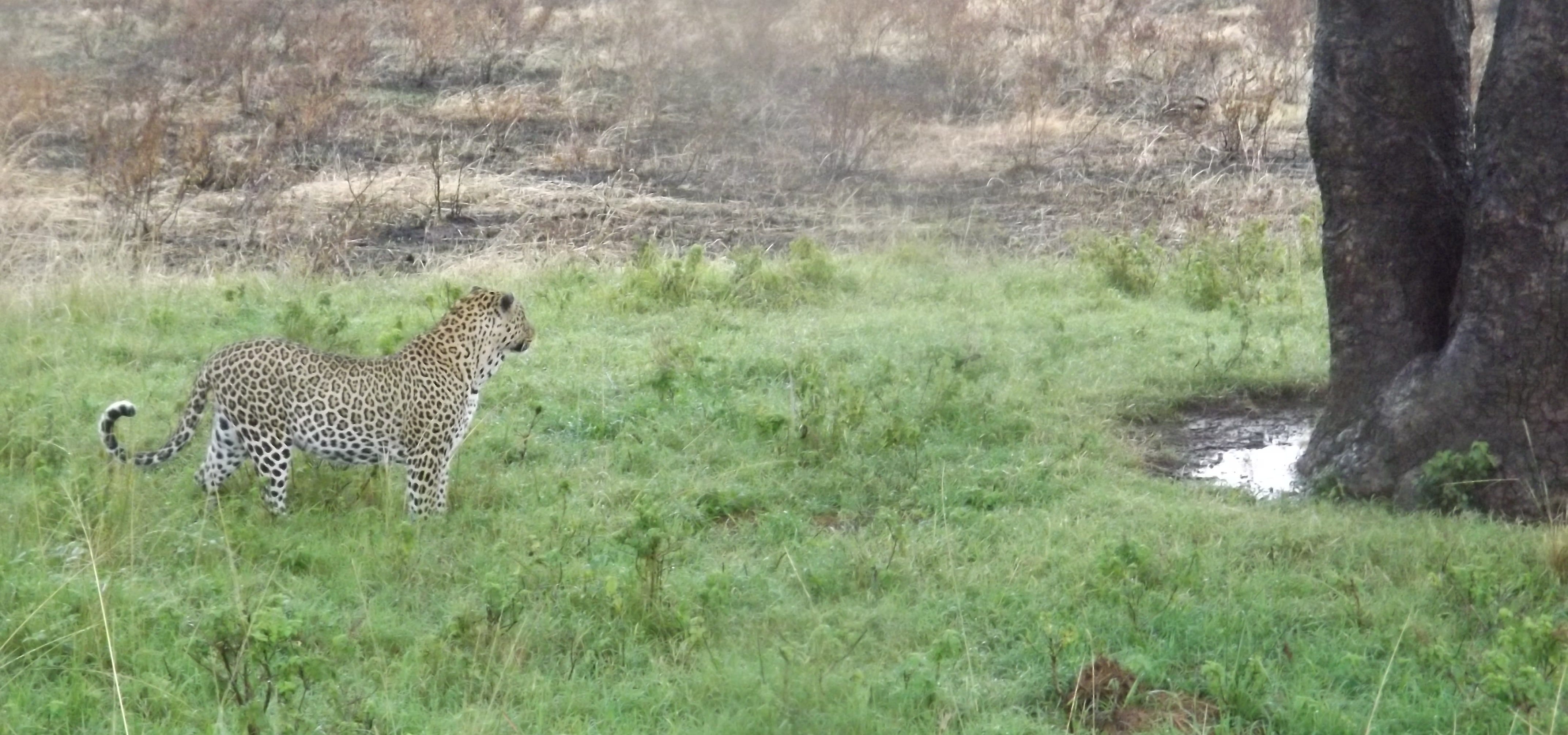
Jackson found the tree. The leopard was in the bush below it. We killed the engine and sat. For ten minutes nothing happened. Then the leopard stood, walked to the base of the tree, and leapt into the branches where an impala carcass had been stored the night before. It tore at the meat. We were a few metres away.
The radio went off almost immediately. Other guides calling in, asking where Jackson was, what he was seeing. Within twenty minutes there were ten vans parked in a rough semicircle around the tree. The leopard didn’t care. It had work to do.
Jackson asked if we’d had enough. He wanted to move before the scene became a car park. Smart. The leopard wasn’t going anywhere, but the experience of watching it was already degrading as more engines idled and more tourists stood through sunroofs with telephoto lenses the size of artillery.
We pulled away. A van passed going the other direction and Jackson slowed, rolled his window down, spoke briefly with the other driver. They swapped information. What Jackson had seen, what the other driver had come from. A radio protocol older than either of them, built on reputation and reciprocity.
This is the part that stays with me.
The network
Jackson’s network has no interface, no dashboard, no analytics. It’s a web of relationships with other guides, built over years of mutual benefit. You share what you see, they share what they see, and everyone’s clients get a better day. The currency is trust, and Jackson is wealthy in it.
Meanwhile, every wildlife charity I’ve seen in the last year is pushing citizen science apps. Download the app, log your sighting, contribute to conservation. WWF has one. The Zoological Society of London has one. The Mara itself is part of a growing network of GPS-collared animals tracked by research organisations across East Africa. Lions, elephants, wild dogs, all fitted with collars that ping satellites every few hours. Dots on a screen. Longitude and latitude instead of eyes and memory.
The data is useful. Conservation needs tracking, needs numbers, needs evidence to counter poaching networks and land-grab developers and governments that would rather pave the Mara than protect it. If a GPS collar saves one lion pride from a farmer’s poisoned carcass, it’s worth every dollar.
But I keep thinking about what gets replaced.
What Jackson knows
Jackson knows where the leopards keep their kills because he’s watched them for fifteen years. He knows which corner of the Mara the cheetahs hunt in the morning because he’s been there when they start running. He knows which water crossings the wildebeest prefer during the migration because he’s watched them choose, year after year, and built a mental map of their habits that no satellite can match.
When a tourist looks at a GPS dot on a screen, they see a location. When they follow Jackson, they see a man who understands why the animal is there. The dot tells you where. Jackson tells you why.
The next morning we were first through the gate. Jackson said a few words into the radio and the speaker exploded with responses. Before the radio had finished crackling, I saw the dust clouds. Vans converging from three directions.
We found a cheetah stalking a Thomson’s gazelle. Jackson positioned us ahead of the chase line, which was pure instinct. He read the cheetah’s body language the way a footballer reads a defender’s hips. The cheetah sprinted. The gazelle cut left. The cheetah cut sharper. One final bound, jaws clamped around the throat, a roll, and the cheetah sat upright with the gazelle twitching beneath it.
A semicircle of vans formed behind us. Front row seats. Another guide might have put us anywhere along the chase line. Jackson put us at the kill.
1978
My mother sent me an email a few weeks before this trip. She’d been to Kenya in 1978, before I was born. August, Amboseli. President Jomo Kenyatta died while they were there. She wrote about the uncertainty, whether to continue the safari or cross into Tanzania, whether Kenya’s stability would hold.
Thirty-five years ago. No GPS collars. No citizen science apps. Just guides with eyes and radios and the knowledge that gets passed down the way it always has in this place, from one man to another, over years.
Jackson is still out there now. The Mara hasn’t changed as much as people think. The roads are worse in March, the grass is higher, the animals are harder to find. But Jackson knows where they are. He doesn’t need a satellite to tell him.
What gets lost
I wonder how long that lasts. Not Jackson himself, but what he represents. A way of knowing that is earned through time and proximity and attention. The kind of knowledge that lives in a person and gets passed on through conversation and shared experience.
When the last guide who learned his routes by following older guides retires, and the next generation finds animals by checking a GPS feed on their phone, something will have been gained. The data will be more complete, more accurate, more shareable. Conservation science will benefit.
But something will also be lost. Jackson doesn’t just know where the animals are. He knows why the grass grows taller on the south side of that particular ridge. He knows which acacia the leopard prefers because the branches fork at the right height for dragging prey. He knows that three vans following him means he’s earned the right to lead and the responsibility that comes with it.
That’s not in the data. It never will be.
The radio crackles. Jackson answers. We move on.