

No app told me to climb Sigiriya. No ranking. No listicle with a stock photo of a sunset and a pull quote about spiritual awakening. A tuk-tuk driver offered me a package deal and I said yes. That’s the whole story of how I ended up here.
Right now Google Maps is rolling out a redesigned mobile app with points of interest baked into the interface. TripAdvisor crossed 200 million monthly visitors last quarter. The entire travel industry is being rebuilt around recommendation algorithms that want to know where you’ve been so they can tell you where to go next. I don’t know what that means for a 200-metre rock in the middle of Sri Lanka’s Cultural Triangle. I know this: the rock was here before the algorithm and it will be here after it. What it wanted from me was stamina, not a five-star review.
Getting in
Sigiriya park entrance is chaos. Six people descend on you the moment your tuk-tuk pulls away, walking alongside you like they were always meant to be your guides. They drift you toward the path heading right, toward the rock. The ticket office is left. Three hundred rupees to enter. I paid, grabbed a two-litre bottle of water for 30 rupees from a vendor near the gate, and took a back path to lose the guides. Best 30 rupees I spent on the whole trip. There are no vendors on the way up.
The first quarter
The climb starts with steps cut into the rock face. Simple enough. Quick ascent, stop for a photo, another quick ascent. With decent stamina you cover the first quarter in about fifteen minutes. The steps are uneven, carved from the living rock, and your legs figure out the rhythm fast or they don’t.
At the top of the first staircase there’s a spiral staircase bolted to the side of the rock. Metal bolts driven into a rock face, a spiral case cantilevered out into open air. If you have a problem with heights or with scaffolding that looks like it was installed by someone with a generous definition of structural integrity, stop here. Go back down. Get a king coconut. As you climb you feel yourself protruding from the side of the rock. The structure holds. It doesn’t feel dangerous. But looking back and seeing how high you’ve risen above the canopy, the stomach does its own maths.
The cave paintings
At the top of the spiral staircase there’s a cave. Inside, some of the most detailed paintings I’ve seen on this trip. Fifteen hundred years old. The care someone took with these, on the side of a rock that required this much effort to reach before anyone had metal scaffolding or carved steps, puts a few things in perspective. You don’t paint like this from the side of a cliff unless the thing you’re painting matters more than the climb.
I started taking photos and noticed a wet trail on the ground leading from where I stood to the cave entrance. I followed it outside and saw it continuing down the stairs. It took me a second. My own sweat. A trail of breadcrumbs from the cave all the way to the base of the rock. I drank half a litre of water in two gulps, thanked the guards for staying out of my photos, and descended the spiral staircase back to the main scaffolding.
Carved steps and lion paws
The next section runs along a pathway flanking the front and side of the rock, then more steps carved directly into stone. The depth and width are fine. The height is the problem. Each step is just tall enough that taking them one at a time feels too slow, but tall enough that taking two at a time burns your quads after thirty seconds. You settle into a rhythm of one-two-one-two, adjusting constantly, your calves filing complaints you ignore.
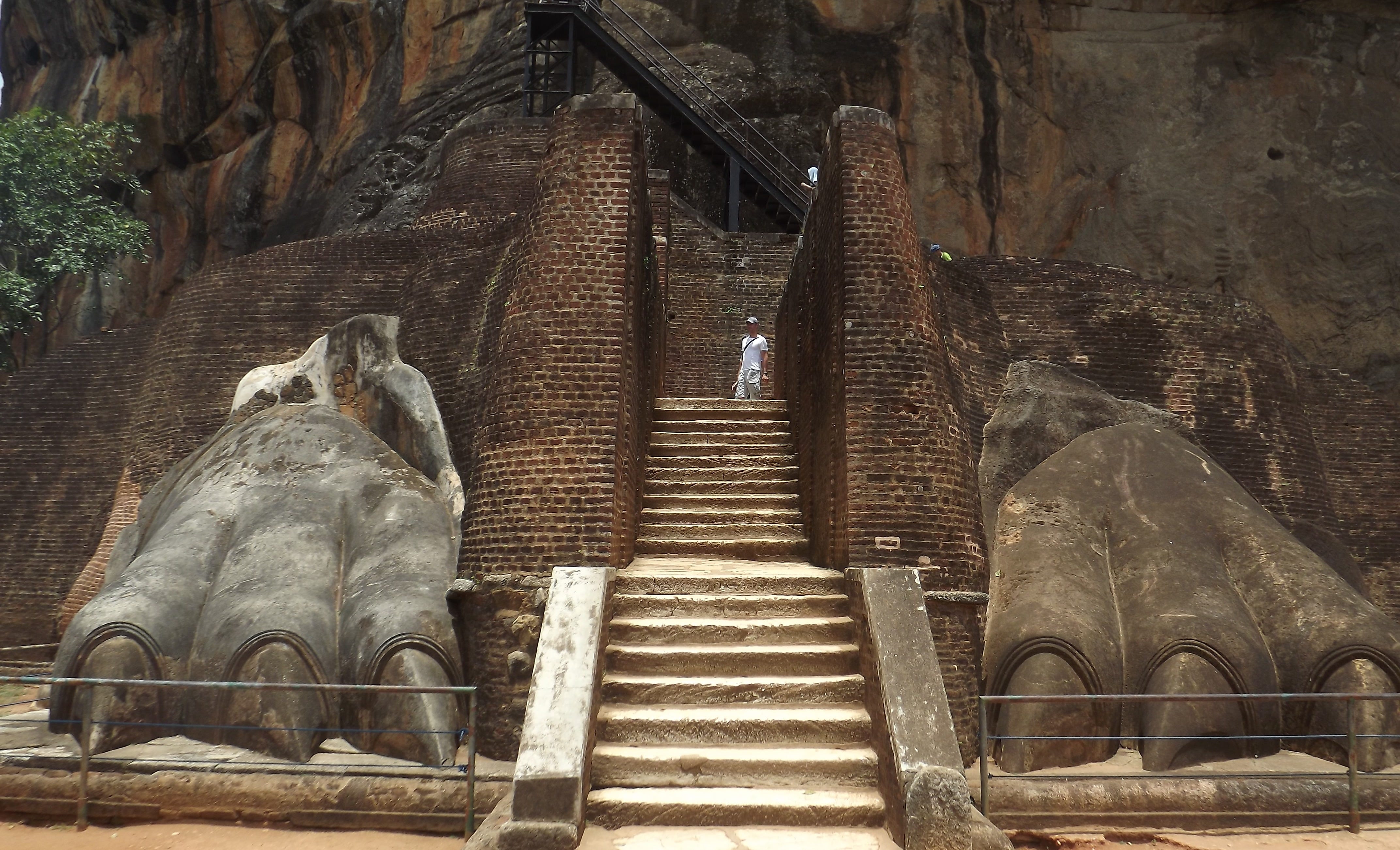
At the base of the Citadel the name makes sense. Lion Rock. Two enormous lion paws carved from the rock flank the final approach. You walk between them.
After ten minutes waiting for a group of tourists to stop sitting on the exact rocks everyone else was trying to photograph, I took my pictures and started the final ascent. I reached the top.
The 70-year-old
The feeling lasted about four minutes. That’s how long it took before a woman in her mid to late seventies came climbing up behind me. Same rock. Same steps. Same spiral staircase. She’d used a slow, steady pace the entire way and she’d made it to the Citadel the same as I had. I’d climbed fast and felt good about it. She climbed at whatever pace worked and got the same view.
Hard to feel like you’ve conquered something when someone twice your age does it right after you without the performance.
I sat in the sun with sweat running off my face, taking in the 360-degree view. Jungle in every direction. The rock drops away below you and there’s nothing but green and sky. I sat there thinking about how lucky I was to be in this spot, doing this, with nowhere to be and no one expecting me anywhere. As carefree as a person gets.
Coming down
Halfway down my legs started cramping. By the time I reached the base I’d decided to walk the 4.6 kilometres back to the hostel. Needed to stretch them out before Dambulla temple the next day, which has its own stairs and its own opinion about your fitness.
As soon as I left the park, a woodworking store appeared. A friendly local waved me inside. To the right, an open factory floor, masks, life-size human carvings, desks, utensils in every shape imaginable. The scale of it was overwhelming. I left wondering if I’d see masks half as good again.
Past the shop, school had just let out. Children streamed past me, testing their English. The day’s lesson must have been introductions because for the next twenty minutes I answered the same three questions on repeat. Who are you? What’s your name? Where are you from? I didn’t mind. A slow walk with no destination works wonders on a body that’s just climbed a 200-metre rock.
Then I almost stepped on a three-foot snake in the middle of the road.
About a kilometre from the guest house I stopped at a small noodle shop and bought two portions of chicken noodles. First hot meal I’d bought on the whole trip. By the time I ate, the noodles were cold. Didn’t matter.
The algorithm question
Somewhere in Mountain View, a team of engineers is building the next version of Google Maps. They’re adding features, refining search, figuring out how to surface the right places to the right people. TripAdvisor’s recommendation engine processes millions of data points daily to serve up personalised travel suggestions. The entire apparatus of modern travel is being rebuilt so that discovery happens on a screen before it happens in a place.
Sigiriya didn’t show up in my feed. No algorithm surfaced it between a hotel booking and a flight search. A man in a tuk-tuk said I take you, good price, and I said yes. The discovery was physical. The proof was in the climb.
There’s a difference between a tool that helps you navigate and a system that decides what’s worth seeing. The rock doesn’t care whether you found it on TripAdvisor or from a tuk-tuk driver. It doesn’t care about your knees or your hydration or your five-star rating. It has steps. Either you climb them or you don’t.
The cave paintings have been there for 1,500 years. The spiral staircase is bolted to the rock face and it holds. A 70-year-old woman reached the top after me. I walked 4.6 kilometres on cramped legs and bought cold noodles and almost stepped on a snake. None of this needed a recommendation engine. It needed a day.
The rock was there. I went up. I came down. The rest is just walking.