

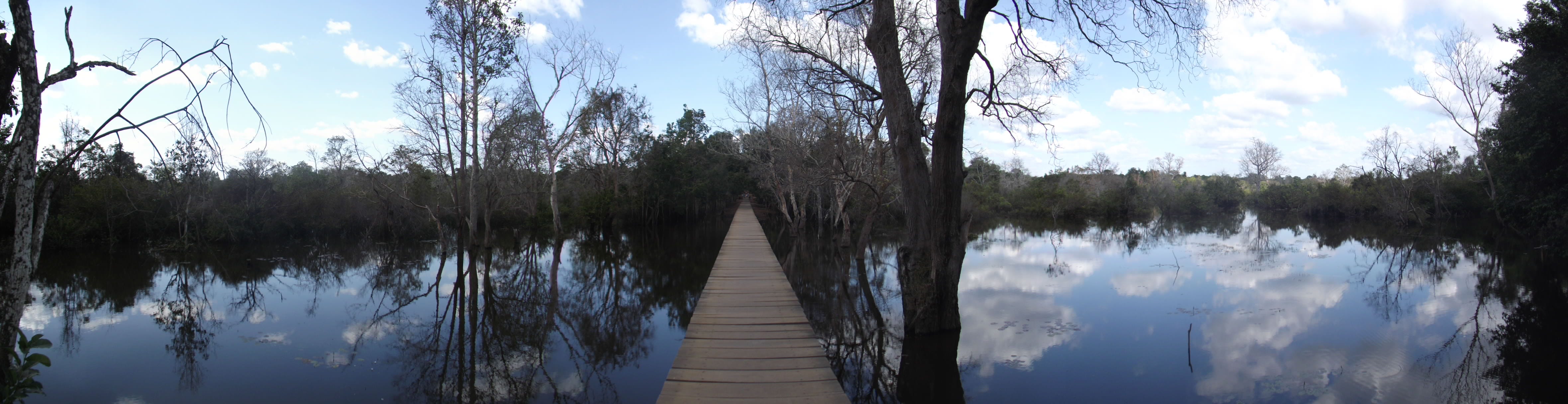
I turned off my phone somewhere over the Indian Ocean. Not airplane mode. Off. The screen went black and I slipped it into the bottom of my backpack, underneath an old book I’d been meaning to read and a wad of Thai baht I'd picked up at Heathrow. I wouldn't turn it on again for thirty-one days.
This was not an accident. I'd been planning it since September, when I finished up my role at a community and marketing team in London and realized I hadn't been fully offline for more than twelve hours in about two years. The longest I'd gone without checking email was a transatlantic flight, and even then I was composing replies in my head, ready to fire them off the moment the wheels touched down.
I told people I was going to Southeast Asia to take photographs. That was true. Angkor Wat at sunrise, the jungle trails outside Chiang Mai, the impossible green of rice paddies in the Cambodian countryside. I had a new camera body and two lenses I barely knew how to use. Photography was the excuse. The real thing I was after was harder to explain.
I wanted to feel what it was like to not know anything.
Not in the abstract, Silicon Valley sense where founders talk about "beginner's mind" over artisanal coffee. I mean actually not knowing. Not knowing how to get from Siem Reap to Bangkok. Not knowing what time it was. Not knowing where to eat, how much things cost, whether I was being ripped off or welcomed. Stripping away every digital crutch I'd built my life around and seeing what was left.
The first week nearly broke me.
Siem Reap is a small town that exists almost entirely because of Angkor Wat, but it doesn't feel small when you're standing on a dusty road at 6 AM trying to figure out how to hire a tuk-tuk for the day. There's no app for this. There's no surge pricing indicator. There's a guy standing next to a motorbike with a carriage welded to the back, and he's looking at you, and you're looking at him, and the whole transaction is going to happen with gestures, a calculator, and whatever broken English he speaks mixed with the zero Khmer you speak.
So you walk up. You point at a map. He says a number. You say a lower number. He laughs. You laugh. He comes down. You go up. You meet somewhere in the middle and spend the next twelve hours together, him driving you through temple complexes so old the trees have swallowed the walls, you sitting in the back with a camera in your lap and sweat running down your spine.
I kept thinking about Uber. I'd used it a few times in London before I left. The entire interaction compressed into a tap and a pin on a map. No negotiation. No eye contact. No relationship at all, really, except a transaction and a rating afterward.
Standing there on that road in Siem Reap, bargaining with my tuk-tuk driver whose name was Sokha, I realized that app had taken this moment, the human moment, and removed it. Not because the moment was broken, but because it was inefficient. And the thing was, Sokha and I ended up spending three days together. He showed me temples the tour groups skip. He introduced me to his cousin who ran a noodle stall near the river. He told me about his daughter and how he wanted her to go to university.
None of that happens in the app. None of it can.
I moved north into Thailand after two weeks in Cambodia. Chiang Mai first, then deeper into the mountains toward the Myanmar border where the roads get bad and the tourists thin out. I was staying in guesthouses that cost four or five dollars a night, places with thin walls and roosters outside the window and shared tables where you ate dinner with whoever else was staying there.
This is how I met people. Not through a feed. Not through a group chat where someone posts a link and three people react with emoji. You sat down, you ordered whatever the family was cooking that night, and you talked to the person across from you. A Dutch woman who'd been cycling through Asia for six months. A retired teacher from Melbourne. A Thai university student home for break who wanted to practice his English and tell me about American rap music.
The conversations were slow. Unguarded. You had nowhere to be because nowhere was calling you. There were no notifications pulling your attention to a screen. You just sat and talked and sometimes the silences lasted a long time and that was fine too.
Back in London I'd been managing community channels where the whole point was connection at scale. Group conversations. Forums. Social platforms where hundreds of people could interact simultaneously. The conversations were good, they were useful, but sitting here I could feel what was missing from them. The pauses. The body language. The way someone leans forward when they're about to say something they actually care about. The shared meal that creates a context for honesty that no threaded discussion can replicate.
A group chat is a simulation of this. A good one, sometimes. But a simulation.
In Hanoi I found the town square.
It wasn't literally a town square. It was a series of them, actually. Little parks and patches of concrete where people gathered every evening as the heat broke. Old men played chess. Children chased each other around fountains. Women sat in clusters and talked with a rapidity that made my head spin. And the news moved through these spaces the way water moves through soil, slowly, person to person, from one knot of people to the next.
Someone would hear something from a relative who worked at the port. A rumor about prices. A story about the government. A bit of gossip about someone's daughter. It would pass from group to group, gaining details and losing others, shaped by each teller. By the end of an evening the whole neighborhood had a shared picture of what was happening, built entirely from oral transmission and face-to-face contact.
Twitter had gone public a month before I left London. I'd been on it for years. But watching these evening gatherings in Hanoi, I understood what it was actually doing. It was recreating the town square at global scale. The rapid exchange. The gossip and rumor mixed with fact. The way a story could spread from one cluster to the next in minutes instead of hours. The collective sense-making that happened when enough people shared what they knew.
The difference was that in Hanoi everyone could see each other's faces. You knew who was trustworthy and who was a blowhard. You could read the room. Online, you can't read the room. There is no room. There's just the feed.
The markets were where I found the last piece.
I'm good at bargaining. It's what I do. BD, sales, negotiations. This is my bread and butter. But I'm used to doing it in English, in meeting rooms, with data backing my position. In the markets of Chiang Mai and Hanoi there is no fixed price. There are no tags. Every transaction is a negotiation, and the price you pay depends on who you are, how many you're buying, what time of day it is, whether the vendor likes your face, and a dozen other variables I couldn't begin to catalog.
I watched a woman buy fish at a morning market in Hanoi. She squeezed the fish, smelled it, argued for two minutes, walked away, came back, and paid a price that I suspect was exactly what she'd intended to pay from the beginning. The whole walk-away was theater. Both of them knew it. The fish vendor adjusted his price based on her body language, her persistence, the fact that she clearly knew fish and he wasn't going to get away with a tourist markup. Dynamic pricing in its purest form. No algorithm needed. Just two humans reading each other.
Uber again. The app that adjusts prices based on demand. That's what this market was doing, except the algorithm was a sixty-year-old woman with thirty years of fish-buying experience encoded in her brain. She was better at it than any software I'd seen.
I don't want to romanticize this. There's a difference between sharpening your skills and needing them to eat. I'm not here to judge how these systems work. I'm here to understand what the tech abstracts when it replaces them.
Something is lost when every human interaction gets optimized. Sokha and I never would have become friends through an app. The Dutch cyclist and I never would have shared a meal if we'd both been staring at our phones. The evening gatherings in Hanoi would lose their character if you could just scroll a timeline instead.
The building blocks of the tech I'd spent the last few years working with didn't come from code. They came from these places. From the way humans have always moved through cities, shared information, bought and sold, talked to strangers. The tech just abstracted the patterns. Stripped away the friction and the context and the mess and left behind something clean, something scalable, something that works.
That's not nothing. Clean and scalable and working matters enormously when you're trying to connect a billion people. But standing in the jungle outside Chiang Rai, camera in hand, no phone, no connection to anyone I knew, I understood something I couldn't have understood from a conference talk or a product demo.
The patterns came from here. From a tuk-tuk negotiation and a shared dinner and a town square at dusk. And when you abstract a pattern, you gain speed and scale, but you lose the texture. The sweat. The laughter. The five-minute silence between two strangers who haven't yet decided if they want to talk. The fish that smells wrong and the vendor who knows you know.
I don't have an answer for this. I'm not arguing we should go backward. I'm not writing a manifesto against technology from a blog that only exists because of technology. I'm just saying I spent a month not using any of it, and when I came back, I could see both what it gives us and what it takes.
That seems worth knowing. Especially if you're the one building it.
I turned my phone back on in the Bangkok airport on December 17th. Fourteen hundred emails. A hundred and twelve notifications on various platforms. Three messages from people who genuinely needed to hear from me.
Everything else could wait. And had. For thirty-one days, the world had gone on without me feeding it updates about my location and my thoughts and what I'd eaten for breakfast. It managed fine.
The flight home was eleven hours. I didn't sleep. I sat with my notebook and wrote down everything I could remember. Not the temples, though I remembered those too. The moments. Sokha's laugh when I tried to bargain in Khmer. The taste of the noodle soup from the first guesthouse. The sound of Hanoi at night, that particular density of motorbikes and voices and cooking smells that no recording has ever captured.
The notebook is still on my desk. I keep opening it. Not for nostalgia. For calibration. When I'm deep in a product conversation or a growth strategy or a community management problem and I start to feel like the abstraction is the thing itself, I go back to those pages and remember.
The thing itself is the woman buying fish. The thing itself is Sokha pointing at a temple I would never have found on my own. The thing itself is a table full of strangers eating dinner together because that's what you do when nobody has anywhere else to be.
Everything we build is just a translation. The question is whether we remember what we're translating from.